Modern Times
Vibe
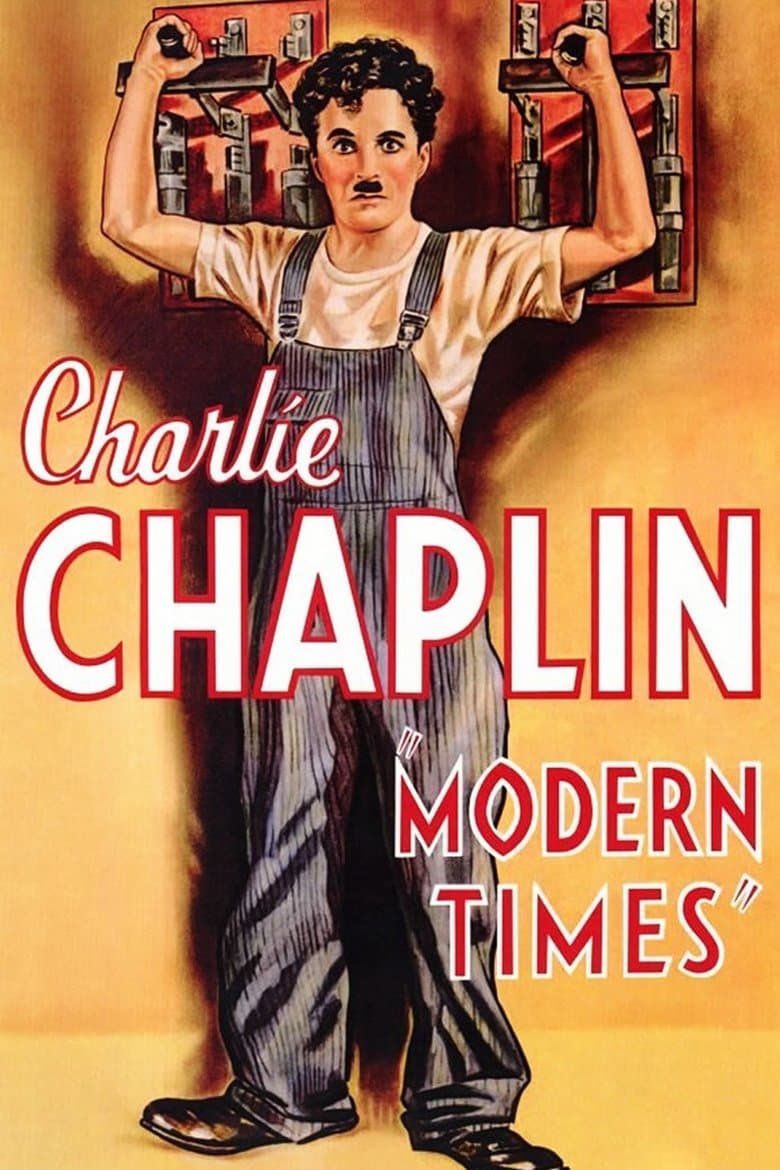
Charlie Chaplin’s satirical comedy follows the Little Tramp as he struggles to survive in an industrial world increasingly ruled by machines, speed, and economic instability. Reduced to a tiny cog on an assembly line, he endures a series of comic breakdowns and misadventures that expose the absurdity and cruelty of modern labor. Chaplin blends dazzling physical comedy with sharp social critique, capturing the anxieties of the Great Depression without losing the Tramp’s resilience or humanity. Released in the sound era but still largely silent in form, Modern Times became both a farewell to Chaplin’s most famous character and one of cinema’s most enduring critiques of industrial society.
Watch for
- Chaplin’s extraordinary physical timing in the factory sequences, where repetitive labor, machine rhythm, and bodily panic are transformed into comic choreography.
- How the film turns industrial spaces and modern inventions into sources of both satire and menace, revealing a world designed for efficiency rather than humanity.
- The relationship between the Tramp and the Gamine, which gives the film emotional warmth and reframes survival as a shared act of hope and resilience.
- The balance between slapstick and political observation, especially in scenes where Chaplin makes social critique feel immediate without ever sacrificing comic momentum.
Production notes
Modern Times was Charlie Chaplin's nominal final appearance as his Tramp character — a comedy about industrialization, mass production, and economic displacement set against the contemporary moment of the Great Depression. Chaplin wrote, produced, directed, scored, and starred. The film was Chaplin's most explicitly political work to that point, with substantial commentary on the dehumanizing effects of assembly-line labor, the criminalization of poverty, and the individualized cost of large-scale economic transformation. Paulette Goddard played the gamin street-orphan who becomes the Tramp's companion. The famous opening factory sequences — the Tramp working an industrial bolt-tightening machine until his body has been mechanized into the machine's rhythm, the disastrous attempt to feed the workers automatically — have become permanent shorthand for industrial alienation. The film was largely silent — using synchronized sound only for the music and brief noise effects — making Chaplin one of the last Hollywood productions to operate substantially in the silent tradition nine years after the introduction of sound. Cinematographer Roland Totheroh shot the film. Production cost approximately $1.5 million.
Trivia
- Modern Times was Charlie Chaplin's last performance as his iconic Tramp character — though Chaplin did not formally announce the retirement at the time, and the role would essentially be retired from his subsequent work; The Great Dictator (1940) included a brief Tramp-like character but as a distinct role.
- Paulette Goddard, who played the gamin street-orphan, was Charlie Chaplin's romantic partner during the production; the two had been together since approximately 1932 and would marry in 1936 (the marriage lasted until 1942), and Goddard's casting was Chaplin's deliberate choice to feature his romantic partner in the role.
- The film was largely silent — using synchronized sound only for the music and brief noise effects — making Chaplin one of the last Hollywood productions to operate substantially in the silent tradition nine years after the 1927 introduction of sound; Chaplin's continued commitment to silent filmmaking was the subject of substantial industry skepticism.
- The famous song 'Smile' — performed by the Tramp as a song-without-words at the film's conclusion — was composed by Chaplin himself and later given lyrics by John Turner and Geoffrey Parsons in 1954; the resulting song became a standard performed by Nat King Cole, Judy Garland, Tony Bennett, Barbra Streisand, and dozens of subsequent artists.
- Modern Times was a commercial success on its 1936 release — grossing approximately $4 million worldwide on its $1.5 million budget — though Chaplin's commercial appeal was beginning to decline relative to his earlier silent-era peak; the film's continuing popular reception came primarily through the subsequent re-releases of the 1950s and 1970s.
Legacy
Modern Times is widely celebrated as one of Charlie Chaplin's masterworks and as the canonical American film treatment of industrialization and economic displacement. It was selected for the inaugural class of the National Film Registry in 1989. The famous opening factory sequences — the Tramp working an industrial bolt-tightening machine until his body has been mechanized into the machine's rhythm — have become permanent shorthand for industrial alienation, regularly referenced in contemporary critical writing about automation and labor displacement. The film's substantial influence on subsequent comic-political cinema has been continuous — from Stanley Kubrick's Dr. Strangelove (1964) to Mike Judge's Office Space (1999) to Charlie Chaplin's own subsequent The Great Dictator (1940) — and the film's specific themes have aged into permanent relevance during subsequent waves of technological displacement. Chaplin's song 'Smile' has become a standard performed by Nat King Cole, Judy Garland, Tony Bennett, Barbra Streisand, and dozens of subsequent artists. Among Chaplin's films, Modern Times sits alongside The Gold Rush (1925) and City Lights (1931) as the canonical achievements of his Tramp era.