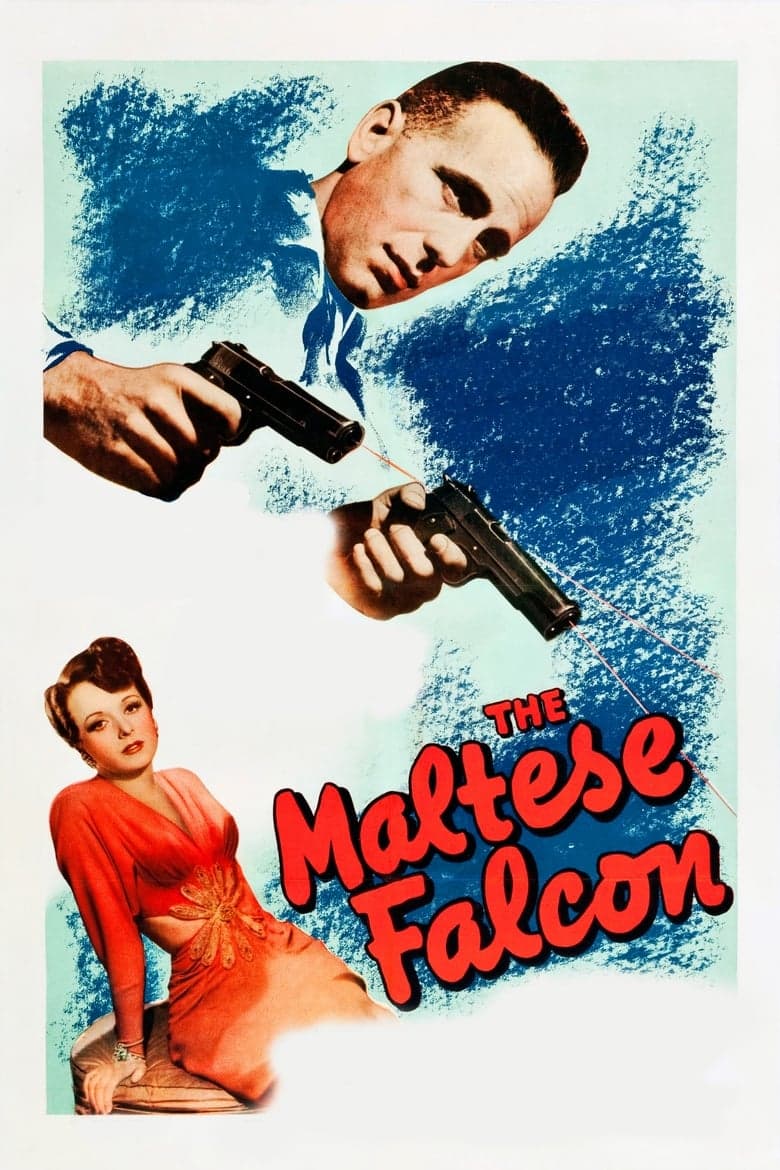
The Maltese Falcon
Vibe
John Huston’s influential detective film follows private investigator Sam Spade as he becomes entangled in a dangerous hunt for a legendary jeweled statue known as the Maltese Falcon. After his partner is mysteriously murdered, Spade finds himself surrounded by a cast of suspicious characters—including the elusive and manipulative Brigid O’Shaughnessy—each determined to claim the priceless artifact. As alliances shift and deception multiplies, Spade must navigate a web of greed, betrayal, and murder. Humphrey Bogart’s cool, morally ambiguous performance helped define the archetype of the hard-boiled detective. With its sharp dialogue, shadowy cinematography, and tightly wound mystery, The Maltese Falcon stands as one of the foundational works of film noir.
Watch for
- Bogart’s controlled performance as Sam Spade, whose calm exterior hides a constantly calculating mind.
- The film’s sharp, fast-paced dialogue, which reveals shifting alliances and hidden motives.
- The shadowy cinematography and claustrophobic interiors that define the film’s noir atmosphere.
- The final revelation about the statue, which underscores the story’s themes of greed and illusion.
Production notes
The Maltese Falcon was John Huston's directorial debut — Huston had been a Warner Bros. screenwriter since 1938 (he co-wrote High Sierra and Sergeant York earlier the same year), and the studio rewarded him with the chance to direct his own adaptation of Dashiell Hammett's 1930 novel. The novel had been filmed twice before — in 1931 and as Satan Met a Lady in 1936 — and both adaptations had failed to capture the source's hard-boiled tone. Huston's screenplay reportedly hewed closely to Hammett's novel, preserving substantial dialogue verbatim. Humphrey Bogart played Sam Spade — a role that established him as a leading-man star after years of supporting work in gangster films. Mary Astor played Brigid O'Shaughnessy, with Sydney Greenstreet (in his film debut at age 61) as Kasper Gutman, Peter Lorre as Joel Cairo, and Elisha Cook Jr. as Wilmer Cook. The film was shot in just 34 days for approximately $375,000 — a relatively modest budget that contributed to the film's tight, stripped-down aesthetic.
Trivia
- Sydney Greenstreet, who plays the corpulent Kasper Gutman, made his film debut at age 61 after a long stage career; The Maltese Falcon launched a film career that included Casablanca and seventeen other films across the next eight years before his retirement.
- John Huston's screenplay reportedly preserved approximately 80 percent of the dialogue verbatim from Dashiell Hammett's novel, an unusually faithful adaptation for the era; Huston was famously a fast and disciplined writer who reportedly completed the screenplay in three weeks.
- The black bird statuettes that prop the climactic scenes were made of plaster — but two later 'lead' replicas were created for promotional purposes; one of these promotional replicas sold at auction in 2013 for $4.085 million, the highest price ever paid at auction for a film prop.
- The famous closing line — 'The stuff that dreams are made of' — is a near-quote from Shakespeare's The Tempest; Huston added the line to the final shooting script, and the scene's allusive quality elevated the otherwise hard-boiled crime narrative.
- Humphrey Bogart's Sam Spade is widely considered his breakthrough role — Bogart had been working in supporting roles for over a decade, and The Maltese Falcon plus High Sierra (released earlier in 1941) launched his decade of leading-man stardom that would peak with Casablanca, To Have and Have Not, The Big Sleep, and The African Queen.
Legacy
The Maltese Falcon established the template for the American film noir tradition — a genre that would dominate Hollywood for the next two decades and shape American cinema for the next eighty years. The film received three Academy Award nominations (no wins). It was selected for the inaugural class of the National Film Registry in 1989. Humphrey Bogart's Sam Spade is one of the canonical detective performances in American cinema, alongside his subsequent Philip Marlowe in The Big Sleep (1946) — together they created the template for every subsequent hard-boiled detective in American film and television. The film's central image — the black bird as the 'stuff that dreams are made of' — became a permanent metaphor for the obsessive pursuit of meaningless objects, embedded in everything from contemporary criticism to William Goldman's screenwriting lectures. Among American films of 1941 — a year that also produced Citizen Kane, How Green Was My Valley, and Sergeant York — The Maltese Falcon remains the most thoroughly influential as genre-originating work, and the film whose stylistic innovations have most thoroughly shaped subsequent American cinema.