Lawrence of Arabia
Vibe
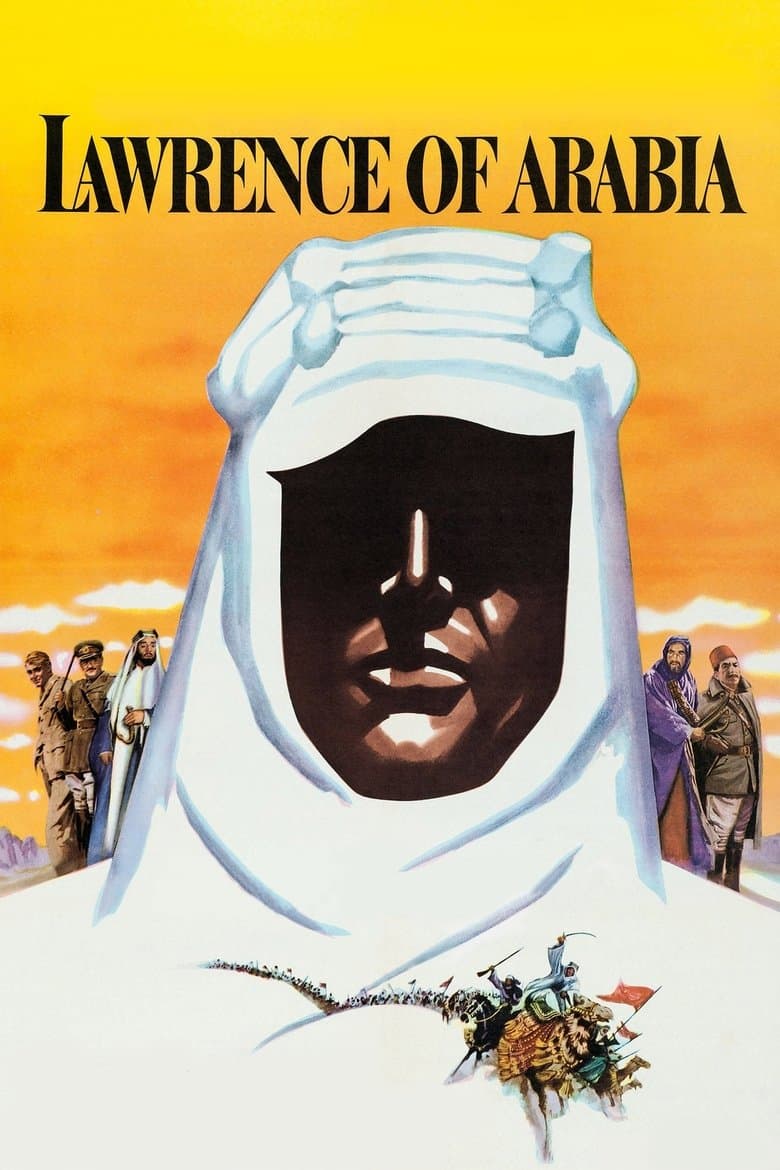
David Lean’s sweeping historical epic tells the story of T. E. Lawrence, a British intelligence officer whose unconventional leadership helped unite Arab tribes against the Ottoman Empire during World War I. Sent to the Middle East as a liaison officer, Lawrence’s daring strategies and charisma transform him into a legendary figure among Arab fighters. Yet as his fame grows, he begins to grapple with the psychological toll of war, the allure of power, and the complicated politics surrounding the British Empire’s promises to its allies. Shot across vast desert landscapes and photographed by Freddie Young in breathtaking widescreen compositions, the film combines grand spectacle with a deeply introspective portrait of ambition and identity. Lawrence of Arabia remains one of cinema’s most visually stunning and influential epics.
Watch for
- The iconic desert imagery, where Lean uses scale, silence, and widescreen composition to emphasize both the beauty and harshness of the landscape.
- Peter O’Toole’s complex performance as Lawrence, capturing the character’s charisma, idealism, and growing inner conflict.
- The famous match cut from a blown-out match to the rising desert sun, one of the most celebrated visual transitions in film history.
- How the film balances sweeping action sequences with quiet moments that reveal Lawrence’s shifting identity and motivations.
Production notes
Lawrence of Arabia was David Lean's epic biographical film about T.E. Lawrence, the British army officer whose role in the Arab Revolt against the Ottoman Empire during World War I had become legend. Producer Sam Spiegel reunited with Lean after their Oscar-winning Bridge on the River Kwai (1957). Robert Bolt and Michael Wilson wrote the screenplay (Wilson was uncredited until the 1990s due to his blacklisting). Peter O'Toole, then virtually unknown, was cast as Lawrence after Marlon Brando declined and Albert Finney turned down the role. The cast included Alec Guinness as Prince Faisal, Anthony Quinn as Auda abu Tayi, Omar Sharif as Sherif Ali (his English-language debut, which earned him a Golden Globe and an Academy Award nomination), Jack Hawkins as General Allenby, and Anthony Quayle as Colonel Brighton. Cinematographer Freddie Young shot the film in 70mm Super Panavision; his desert vistas became some of the most influential landscape cinematography in film history. Maurice Jarre composed the score. Production took two years across Jordan, Spain, Morocco, and England. The film cost approximately $15 million — an enormous budget for 1962.
Trivia
- Peter O'Toole was 29 and virtually unknown when he was cast as Lawrence after Marlon Brando declined and Albert Finney turned down the role; the role made him an international star and earned him the first of eight Academy Award nominations he would receive without ever winning competitively.
- The famous 'mirage' shot of Omar Sharif's Sherif Ali emerging from the desert horizon required the production to dig a hole roughly 1,000 feet from the camera and have Sharif ride toward it; the sequence was shot in a single take and reportedly required only one attempt.
- Cinematographer Freddie Young shot the famous match-cut transition — Lawrence blowing out a match, immediately cutting to a desert sunrise — using a special technique that required precise frame-by-frame timing; the cut has been studied as one of the great editing moments in cinema.
- Composer Maurice Jarre wrote the iconic main theme in approximately six weeks under enormous pressure; David Lean had originally planned to use a different composer, and Jarre was hired as a last-minute replacement.
- Lawrence of Arabia received ten Academy Award nominations and won seven — including Best Picture, Best Director, and Best Cinematography — but Peter O'Toole lost Best Actor to Gregory Peck for To Kill a Mockingbird, an outcome widely considered one of the greatest snubs in Oscar history.
Legacy
Lawrence of Arabia is widely regarded as one of the greatest films ever made, particularly for its achievements in epic-scale cinematography and biographical storytelling. It won seven Academy Awards including Best Picture and Best Director, and was selected for the National Film Registry in 1991. Steven Spielberg has said the film inspired him to become a director, and his subsequent epic work — particularly Indiana Jones and the Last Crusade and Empire of the Sun — bears Lean's direct influence. The film's 1989 director's-cut restoration by Robert A. Harris reintroduced 35 minutes of previously lost footage and is now the definitive version. Peter O'Toole's central performance — by turns charismatic, troubled, narcissistic, and tragic — established him as one of the great screen actors of his generation. The film's representation of Arab characters, of British colonialism, and of T.E. Lawrence himself has been the subject of substantial postcolonial critical reassessment, but its position as one of the high-water marks of pre-digital epic filmmaking has remained unchallenged.