Jaws
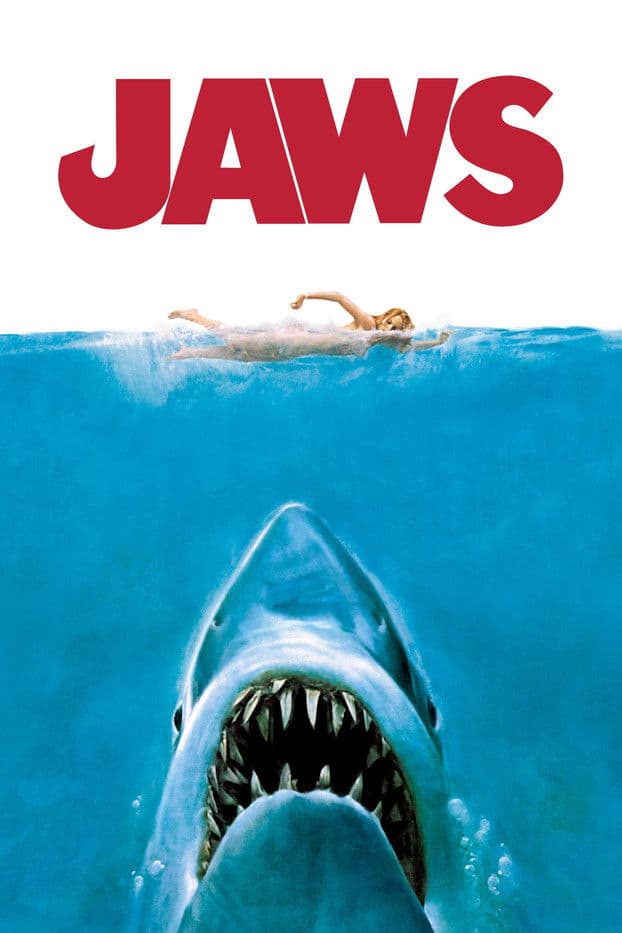
Vibe
Steven Spielberg’s gripping thriller follows police chief Martin Brody as he tries to protect the beach town of Amity Island from a great white shark attacking swimmers just as the summer season begins. Joined by marine biologist Matt Hooper and the hard-bitten shark hunter Quint, Brody heads out to sea on a dangerous hunt that becomes as much a test of character as survival. Spielberg builds extraordinary suspense through suggestion, rhythm, and point of view, often withholding the shark itself while John Williams’s ominous score does the work of dread. With its unforgettable set pieces, sharply drawn characters, and immense popular impact, Jaws remains one of the most effective thrillers ever made.
Watch for
- How Spielberg delays full views of the shark, using water-level camera placement, reaction shots, and editing to make unseen danger feel overwhelming.
- John Williams’s two-note theme, which turns a simple musical idea into one of the most effective suspense devices in film history.
- The contrast among Brody, Hooper, and Quint, whose clashing temperaments give the film its human drama once the story moves offshore.
- The Indianapolis monologue and the final boat sequences, where the film shifts from beach-town panic to a stripped-down battle of endurance, obsession, and fear.
Production notes
Jaws was Steven Spielberg's adaptation of Peter Benchley's 1974 best-selling novel, with the screenplay credited to Benchley and Carl Gottlieb. The production became famously chaotic — the mechanical sharks (collectively nicknamed 'Bruce' after Spielberg's lawyer) repeatedly broke down in the salt water off Martha's Vineyard, the schedule fell substantially behind, and the budget ballooned from approximately $4 million to $9 million. Spielberg has said the shark malfunctions actually improved the film by forcing him to keep the creature off-screen for most of the movie, creating the suspense that the story now famously depends on. Roy Scheider played Police Chief Brody, with Robert Shaw as the shark hunter Quint, Richard Dreyfuss as the marine biologist Hooper, and Lorraine Gary as Brody's wife Ellen. The famous 'USS Indianapolis' speech delivered by Robert Shaw was reportedly rewritten by the actor himself the night before filming after Shaw thought the originally-scripted version was inadequate. Cinematographer Bill Butler shot the film. Composer John Williams contributed the iconic two-note shark theme. Production wrapped after nearly five months — well over schedule.
Trivia
- The mechanical sharks (collectively nicknamed 'Bruce' after Spielberg's lawyer) repeatedly broke down in the salt water off Martha's Vineyard during production; Steven Spielberg has said the shark malfunctions actually improved the film by forcing him to keep the creature off-screen for most of the movie, creating the suspense that the story now famously depends on.
- The famous 'USS Indianapolis' speech delivered by Robert Shaw — recounting the actual 1945 sinking of the USS Indianapolis and the resulting shark attacks on its survivors — was reportedly rewritten by the actor himself the night before filming after Shaw thought the originally-scripted version was inadequate.
- Jaws is widely credited as the first 'summer blockbuster' — its enormous commercial success in summer 1975 and its broad-release marketing approach (rather than the limited-roll-out strategy that had dominated earlier decades) established the template for the summer-tentpole release pattern that has shaped Hollywood economics ever since.
- John Williams's iconic two-note shark theme was reportedly Spielberg's initial reaction was disbelief — he asked Williams 'is this a joke?' before realizing the simplicity was the point; the theme has become one of the most recognizable pieces of film music ever composed and a permanent shorthand for impending threat.
- Jaws grossed approximately $470 million worldwide on its $9 million production budget — a return that made it the highest-grossing film of all time at its 1975 release, surpassing The Godfather, before Star Wars surpassed it in 1977 to begin a decade of escalating blockbuster competition.
Legacy
Jaws is widely credited as the first modern summer blockbuster — the film whose commercial success in summer 1975 established the template for the summer-tentpole release pattern that has shaped Hollywood economics ever since. It received four Academy Award nominations and won three (Best Original Score for John Williams, Best Sound, Best Film Editing); it lost Best Picture to One Flew Over the Cuckoo's Nest. It was selected for the National Film Registry in 2001. The film's success demonstrated that genre cinema (horror-thriller-adventure) could compete commercially with prestige drama at the highest tier of release — a lesson that subsequent decades of Hollywood would absorb thoroughly. John Williams's two-note shark theme has become one of the most recognizable pieces of film music ever composed. Robert Shaw's 'USS Indianapolis' speech is regularly cited as one of the great single-take monologues in American cinema. Among Steven Spielberg's films, Jaws is the work that established him as the dominant commercial-blockbuster director of his generation, opening the way to Close Encounters, Raiders, E.T., Jurassic Park, and the entire subsequent franchise architecture of his career.