High Noon
Vibe
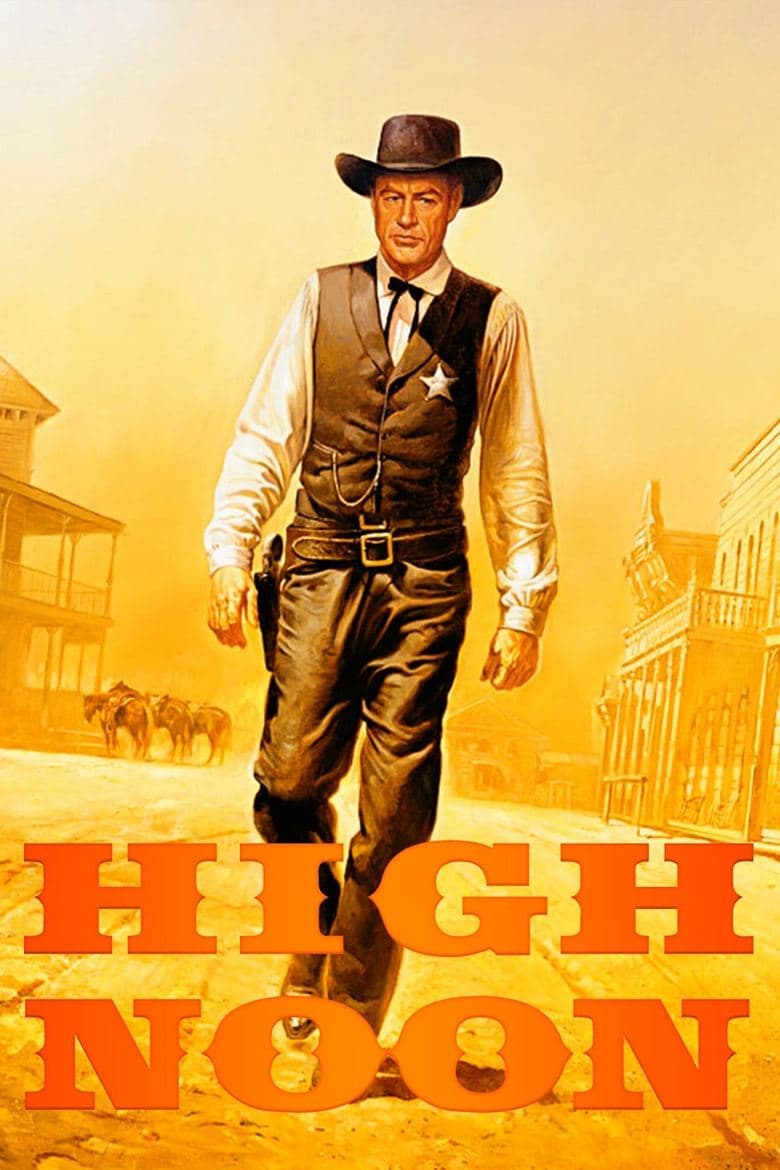
Fred Zinnemann’s tense Western unfolds almost in real time as Marshal Will Kane learns that a vengeful outlaw is arriving on the noon train. Newly married and ready to leave town behind, Kane instead chooses to stay and face the threat, only to find himself deserted by the very community he once protected. As the clock ticks steadily toward confrontation, the film becomes a stark portrait of duty, fear, and moral isolation. Gary Cooper’s restrained performance gives Kane a weary but unshakable resolve, while Zinnemann’s spare direction heightens the suspense through mounting inevitability. High Noon remains one of the most influential Westerns ever made and a lasting meditation on courage under pressure.
Watch for
- The recurring clocks and time checks, which turn the film’s countdown to noon into a constant source of tension.
- Gary Cooper’s understated performance, especially the way fatigue, disappointment, and determination register in small gestures.
- How the townspeople’s excuses and evasions gradually reveal the film’s deeper critique of fear and moral cowardice.
- Zinnemann’s sparse visual style, which strips the showdown of glamour and makes the final confrontation feel stark and inevitable.
Production notes
High Noon was Fred Zinnemann's western starring Gary Cooper, produced by Stanley Kramer at his newly-formed independent production company. Carl Foreman wrote the screenplay; Foreman was being investigated by the House Un-American Activities Committee during production, and was reportedly writing the film as an allegory for the contemporary Hollywood blacklist — the marshal abandoned by his town as House Un-American Activities Committee witnesses were being abandoned by Hollywood colleagues. Foreman would be blacklisted shortly after the film's release. Gary Cooper played Marshal Will Kane, with Grace Kelly (in only her second film role) as his Quaker bride Amy, Lloyd Bridges as the deputy Harvey Pell, Katy Jurado as the Mexican former lover Helen Ramirez, and Lon Chaney Jr. as the retired sheriff Martin Howe. Cinematographer Floyd Crosby shot the film in deliberately stark black-and-white. The film's running time approximately matches the screen time — a real-time structure unusual for the western genre. Composer Dimitri Tiomkin contributed the iconic 'Do Not Forsake Me, Oh My Darlin'' theme. Production cost approximately $730,000.
Trivia
- Carl Foreman's screenplay was widely understood as an allegory for the contemporary Hollywood blacklist — the marshal abandoned by his town as House Un-American Activities Committee witnesses were being abandoned by Hollywood colleagues; Foreman was blacklisted himself shortly after the film's release.
- John Wayne reportedly considered High Noon 'the most un-American thing I've ever seen' and made his own anti-allegory western Rio Bravo (1959) explicitly as a rebuttal — Rio Bravo's marshal does have help from his community, deliberately reversing High Noon's central premise.
- Grace Kelly was 22 when the film was shot and was a virtual unknown; the role launched her three-year Hollywood career that would peak with Hitchcock's Rear Window (1954), To Catch a Thief (1955), and her Oscar-winning role in The Country Girl (1954) before her 1956 marriage to Prince Rainier III ended her acting career.
- The film's running time approximately matches its real-time narrative — the 85-minute film depicts approximately 85 minutes of in-story events leading up to and including the noon-hour gunfight; this real-time structure was extraordinarily innovative for the western genre.
- High Noon won four Academy Awards including Best Actor (Gary Cooper), Best Original Song ('Do Not Forsake Me, Oh My Darlin''), Best Original Score (Dimitri Tiomkin), and Best Film Editing; it lost Best Picture to The Greatest Show on Earth in one of the more contested Oscar contests of the early 1950s.
Legacy
High Noon won four Academy Awards including Best Actor for Gary Cooper, and was selected for the inaugural class of the National Film Registry in 1989. The film has been continuously celebrated as one of the finest American westerns and as the canonical text of moral courage under social abandonment. President Bill Clinton famously said it was his favorite film, and reportedly screened it during his 1998 impeachment proceedings; subsequent presidents from George W. Bush to Barack Obama have invoked the film in remarks about leadership under pressure. The film's specific allegorical content regarding the Hollywood blacklist has aged into permanent relevance — High Noon is one of the few studio-era American films whose specific political subtext has remained legible across decades of subsequent reception. John Wayne's 'most un-American thing I've ever seen' criticism and his anti-allegory Rio Bravo (1959) gave the western genre one of its most explicit ideological internal arguments. Among American westerns of the studio era, High Noon stands as the most thoroughly serious treatment of community moral failure under crisis.