The Grapes of Wrath
Vibe
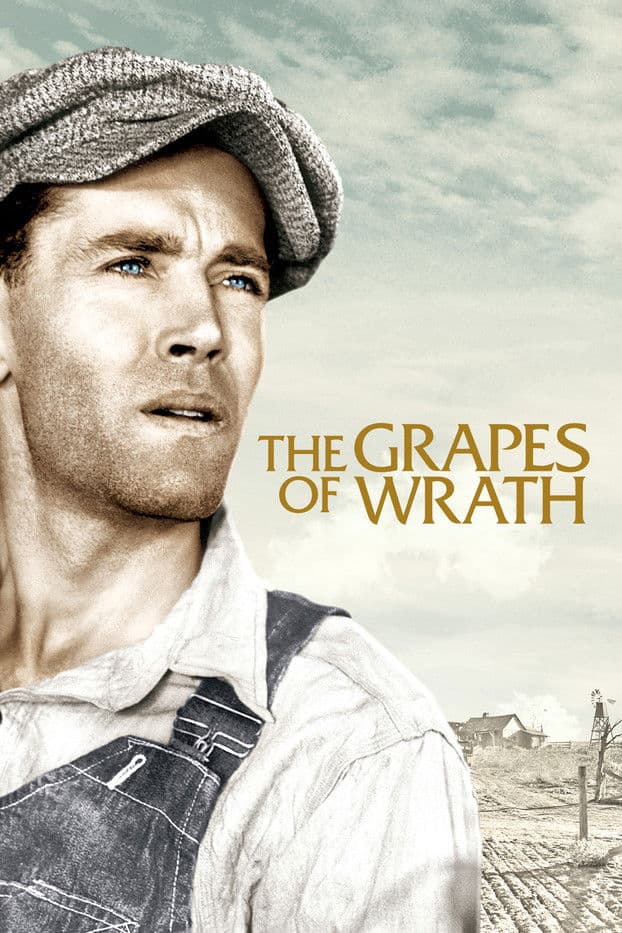
John Ford’s powerful adaptation of John Steinbeck’s novel follows the Joad family as they leave their Oklahoma farm after the devastation of the Dust Bowl. Hoping to find work and a better future, they travel west to California along with thousands of other displaced families during the Great Depression. What they discover instead is widespread poverty, exploitation, and hostility toward migrant laborers. Through the experiences of Tom Joad and his family, the film portrays both the hardship and resilience of people struggling to survive during one of America’s most difficult eras. Ford’s restrained direction and Gregg Toland’s stark cinematography give the story a documentary-like realism, while Henry Fonda’s performance anchors the film’s themes of justice, dignity, and compassion.
Watch for
- Henry Fonda’s understated performance as Tom Joad, whose growing awareness of injustice shapes the film’s moral center.
- Gregg Toland’s expressive black-and-white cinematography, which captures both the harsh landscapes and intimate human moments.
- Scenes depicting migrant camps and labor struggles, which highlight the systemic exploitation faced by displaced workers.
- Tom Joad’s final speech, one of the most memorable declarations of social conscience in American cinema.
Production notes
The Grapes of Wrath was John Ford's adaptation of John Steinbeck's 1939 Pulitzer Prize-winning novel, produced by Darryl F. Zanuck for 20th Century Fox at extraordinary speed — the studio acquired film rights immediately on novel publication, and the film was in theaters within 12 months. Nunnally Johnson wrote the screenplay, working closely with Steinbeck to maintain the novel's central social-criticism content while making it acceptable to studio leadership. Henry Fonda played Tom Joad, with Jane Darwell as Ma Joad, John Carradine as Jim Casy, and Charley Grapewin as Grandpa Joad. Cinematographer Gregg Toland (the same year Toland was working on Citizen Kane for Welles) shot the film in deeply atmospheric black-and-white that drew on his documentary-influenced approach to lighting. The film was shot partly on actual Route 66 locations across the Southwest; production took approximately seven weeks. Composer Alfred Newman scored the film, with arrangements of traditional folk songs including 'Red River Valley.' Production cost approximately $750,000.
Trivia
- John Steinbeck reportedly told producer Darryl F. Zanuck after seeing the finished film: 'It's a hard, straight picture in which the actors are submerged so completely that the people in the audience think they're seeing real people' — one of the more glowing author-on-adaptation endorsements in Hollywood history.
- Cinematographer Gregg Toland shot The Grapes of Wrath the same year he was photographing Citizen Kane for Orson Welles; the two films, released months apart, established Toland as the most influential cinematographer of his era and showcased two distinct branches of his visual approach.
- Tom Joad's famous closing 'I'll be there' speech was preserved largely verbatim from Steinbeck's novel; the scene has become one of the most-quoted populist political moments in American cinema, with subsequent invocations from Bruce Springsteen ('The Ghost of Tom Joad') to Bernie Sanders.
- The film's portrayal of the migrant-camp government work programs was one of the few sympathetic depictions of Roosevelt's New Deal that received mass-market Hollywood distribution; the film effectively functioned as cultural endorsement of Federal policy at a politically tense moment.
- Jane Darwell won the Academy Award for Best Supporting Actress for her performance as Ma Joad, and director John Ford won Best Director — but the film lost Best Picture to Rebecca, which was the more glamorous contender that year.
Legacy
The Grapes of Wrath won two Academy Awards — Best Director (Ford) and Best Supporting Actress (Darwell) — and was nominated for five more including Best Picture. It was selected for the inaugural class of the National Film Registry in 1989. Tom Joad's famous closing 'I'll be there' monologue has become one of the most-quoted populist political speeches in American cinema, regularly invoked across decades of American political discourse. The film's depiction of Depression-era migrant suffering was extraordinarily influential at its 1940 release — both as shaper of public consciousness about economic dislocation and as endorsement of Roosevelt's New Deal labor programs. Bruce Springsteen's 1995 album The Ghost of Tom Joad explicitly invoked the film's central character as continuing reference for working-class American suffering. Among American films about poverty and economic hardship, The Grapes of Wrath remains the canonical studio-era treatment, and its Henry Fonda performance is widely considered one of the great American film performances. Among Ford's films, it stands as his most sustained engagement with explicit social criticism.