The Godfather Part II
Vibe
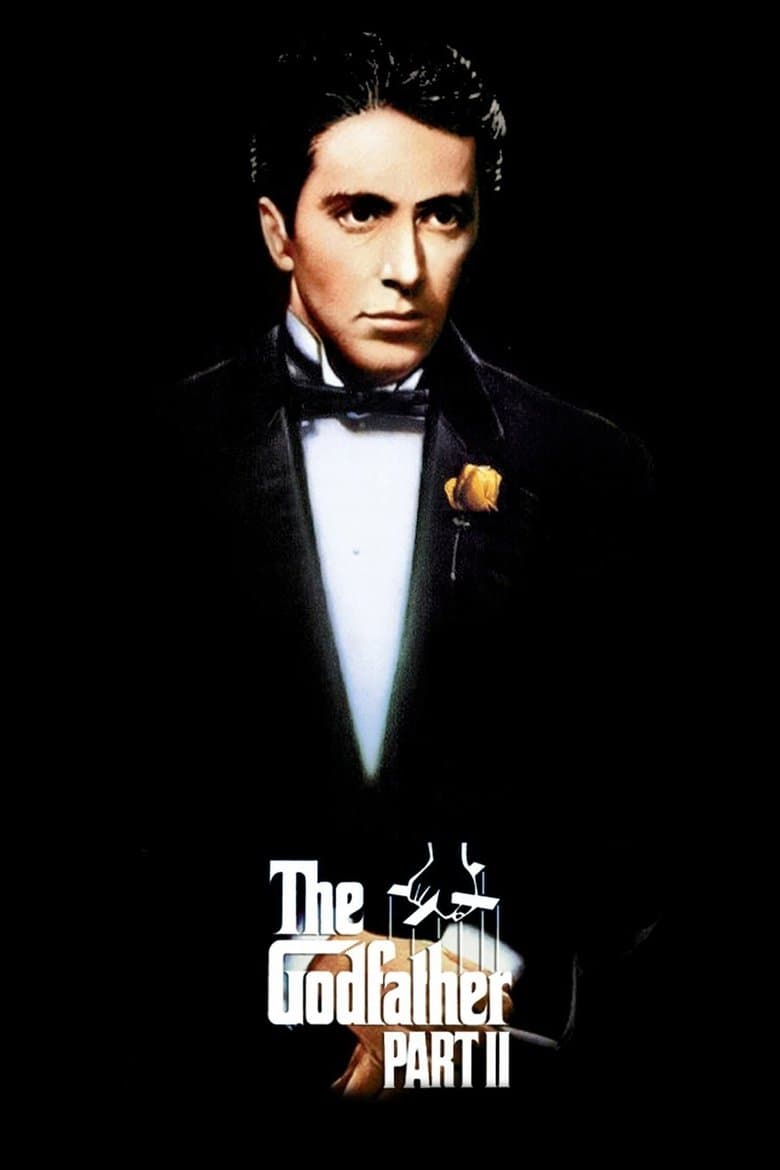
Francis Ford Coppola’s sequel expands the Corleone saga through two parallel narratives that deepen the family’s tragic legacy. One follows Michael Corleone as he tightens his grip on the family empire while growing ever more isolated by suspicion, betrayal, and his own ruthless choices. The other traces the rise of his father, Vito Corleone, from orphaned Sicilian immigrant to powerful and respected Mafia leader in New York. Al Pacino and Robert De Niro deliver haunting performances that reveal two very different paths to power. Darker, broader, and more reflective than its predecessor, The Godfather Part II stands as one of cinema’s greatest sequels and one of its most devastating portraits of family, ambition, and moral decay.
Watch for
- The contrast between Robert De Niro’s patient, quietly strategic Vito and Al Pacino’s colder, increasingly isolated Michael.
- How Coppola crosscuts between past and present to show how the family’s values evolve—and curdle—across generations.
- The Havana sequences and Senate hearings, which widen the story from family drama into a portrait of political power and criminal influence.
- Michael’s stillness and silences, where Pacino conveys paranoia, grief, and emotional collapse with minimal outward expression.
Production notes
The Godfather Part II was Francis Ford Coppola's sequel to his 1972 success — and his attempt to transform what could have been a commercial sequel into a genuinely ambitious work of dual-narrative cinema. The film weaves Michael Corleone's contemporary descent into corruption (set in the late 1950s) with parallel flashback sequences chronicling young Vito Corleone's rise in early-twentieth-century New York City. Robert De Niro played young Vito, learning Sicilian dialect for the role and performing most of his dialogue in Italian — a striking choice that won him the Academy Award for Best Supporting Actor (the only time two actors have won Oscars for playing the same character across two separate films). Al Pacino reprised Michael Corleone, with Diane Keaton as Kay, Robert Duvall as Tom Hagen, John Cazale as Fredo, Talia Shire as Connie, and Lee Strasberg (in his only feature film role) as Hyman Roth. Coppola wrote the screenplay with Mario Puzo. Cinematographer Gordon Willis returned. Production cost approximately $13 million.
Trivia
- Robert De Niro learned Sicilian dialect for the role of young Vito Corleone and performed most of his dialogue in Italian; he won the Academy Award for Best Supporting Actor in his second Oscar nomination, and his Vito remains the only Oscar-winning performance largely conducted in a language other than English.
- Marlon Brando and Robert De Niro became the only two actors to win Academy Awards for playing the same character — Vito Corleone — across two separate films; Brando had won Best Actor for the 1972 original, and De Niro won Best Supporting Actor for the 1974 sequel.
- Lee Strasberg, the legendary Method-acting teacher whose students included Brando, James Dean, Paul Newman, and many others, made his only feature-film acting appearance as the Jewish gangster Hyman Roth (modeled on real-life Meyer Lansky); Strasberg was 73 at the time and was nominated for the Academy Award for Best Supporting Actor for the role.
- The Godfather Part II was the first sequel ever to win the Academy Award for Best Picture; the achievement has only been matched a handful of times since (most notably by Lord of the Rings: Return of the King in 2003).
- Together with The Godfather, the two films won fourteen Academy Awards on twenty-nine nominations — the most of any film series in history at that time, with the franchise's combined Oscar dominance establishing Coppola as one of the most thoroughly Academy-favored directors of his generation.
Legacy
The Godfather Part II is one of the most acclaimed sequels ever made and is regularly cited as one of the rare cases where a sequel matches or surpasses its original. It won six Academy Awards including Best Picture (the first sequel ever to do so), Best Director (Coppola), Best Adapted Screenplay, Best Supporting Actor (De Niro), Best Original Score, and Best Art Direction. It was selected for the National Film Registry in 1993. The dual-narrative structure — interweaving Michael's contemporary descent with Vito's parallel rise — has been continuously studied as the canonical American example of how cinema can use parallel timeframes to deepen thematic meaning. Robert De Niro's young Vito performance launched the actor's collaboration with Martin Scorsese that would define both careers across the next forty years (Mean Streets had preceded it in 1973, but Godfather II established De Niro as a major dramatic actor). Among American film series, the Godfather sequence — with its 1972 original and its 1974 sequel — remains the canonical example of two films functioning as a single sustained dramatic work.