Giant
Vibe
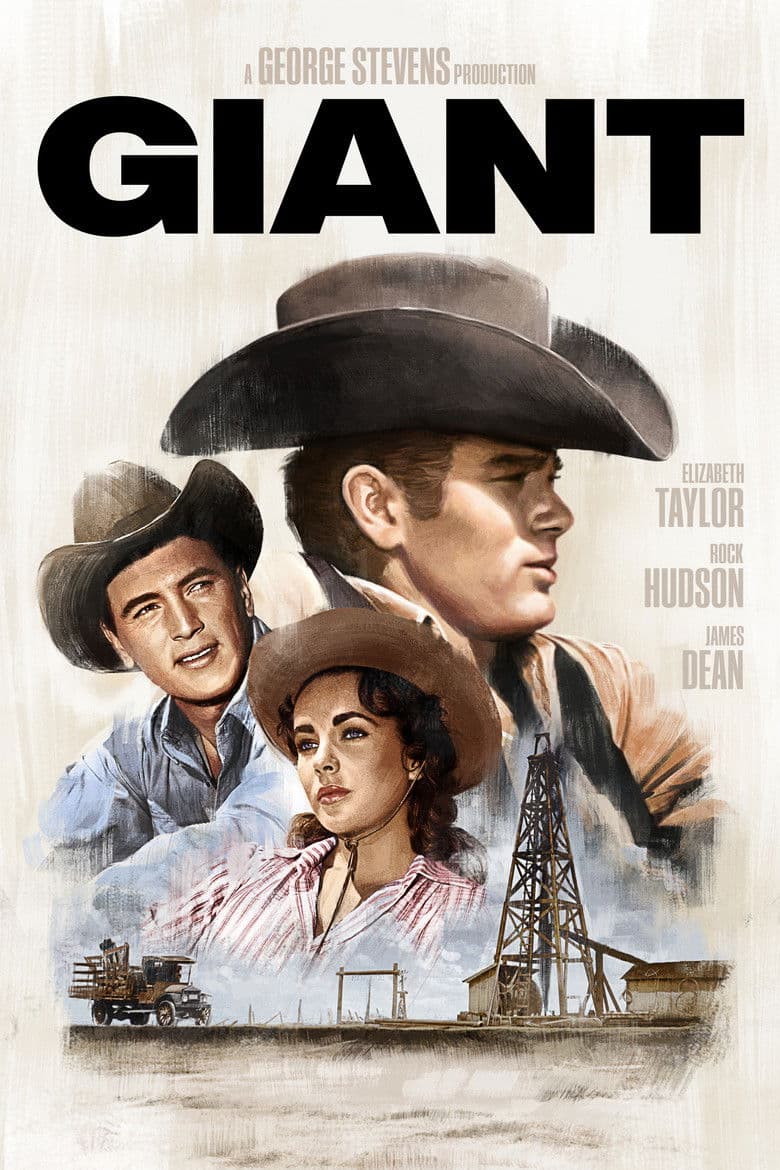
George Stevens’s sweeping drama traces decades of change in Texas through the intersecting lives of rancher Bick Benedict, his socially conscious wife Leslie, and the fiercely ambitious Jett Rink. As the state shifts from a world defined by cattle and land to one transformed by oil wealth, personal rivalries and cultural tensions reshape both family and identity. Rock Hudson and Elizabeth Taylor ground the film’s emotional core, while James Dean gives Jett a volatile hunger that turns resentment into restless ambition. Blending family saga with social critique, Giant uses epic scale to examine class, racism, masculinity, and generational change in the modern American West.
Watch for
- How the film uses time jumps and family milestones to show social change gradually reshaping both the Benedict household and Texas itself.
- James Dean’s performance as Jett Rink, whose insecurity, desire, and resentment simmer underneath every gesture even as he gains wealth and status.
- The contrast between Leslie’s outsider perspective and Bick’s inherited assumptions, which gives the film much of its moral and emotional tension.
- The way Stevens balances sweeping landscapes, oil-field spectacle, and intimate domestic confrontations, turning private conflict into a larger portrait of American transformation.
Production notes
Giant was George Stevens's three-hour epic adaptation of Edna Ferber's 1952 novel about Texas ranching, oil, and changing social conventions across approximately 25 years (roughly 1923 through 1947). The screenplay was credited to Fred Guiol and Ivan Moffat, with substantial additional contributions from Edna Ferber herself and uncredited work by Carroll Baker. Rock Hudson played the patriarch Texas rancher Jordan 'Bick' Benedict Jr., with Elizabeth Taylor as his Eastern-born wife Leslie Lynnton Benedict and James Dean (in his third and final completed feature film before his September 30, 1955 fatal car accident) as the embittered oil-strike millionaire Jett Rink. The cast included Carroll Baker, Jane Withers, Dennis Hopper (in his second film), Sal Mineo, Rod Taylor, Mercedes McCambridge, and a young Earl Holliman. The film was shot extensively on location in Marfa, Texas — the actual ranching country of the source novel — with substantial use of the Reata Ranch as the Benedict family estate. Cinematographer William C. Mellor shot the film. Composer Dimitri Tiomkin contributed the score. Production cost approximately $5.4 million.
Trivia
- James Dean's role as the embittered oil-strike millionaire Jett Rink was his third and final completed feature film performance; Dean died in a car accident in Cholame, California on September 30, 1955 — approximately one year before the October 10, 1956 theatrical release — and received a posthumous Academy Award nomination for Best Actor.
- James Dean's posthumous Best Actor Academy Award nomination for Giant — his second posthumous nomination after East of Eden (1955) — made him the first actor in Oscar history to receive two posthumous Best Actor nominations; Dean lost the 1956 award to Yul Brynner for The King and I.
- Elizabeth Taylor was 23 when she made Giant and was already an established Hollywood star after her childhood breakthrough in National Velvet (1944); her role as Leslie Lynnton Benedict established her as a major leading lady in adult dramatic roles and opened the way to her subsequent decade of major work.
- The film was shot extensively on location in Marfa, Texas — the actual ranching country of the source novel — with the Reata Ranch (a constructed exterior set) becoming a permanent local landmark; the production substantially shaped the small Texas town's identity, and Marfa would later become a major contemporary-art destination through the Donald Judd Chinati Foundation.
- Giant received ten Academy Award nominations including Best Picture, Best Director (Stevens), Best Actor (Rock Hudson and James Dean both nominated), and Best Actress (Mercedes McCambridge for supporting); Stevens won Best Director, but the film lost Best Picture to Around the World in 80 Days in one of the more contested 1956 Oscar contests.
Legacy
Giant received ten Academy Award nominations and won one — Best Director for George Stevens; it lost Best Picture to Around the World in 80 Days. It was selected for the National Film Registry in 2005. James Dean's posthumous Best Actor nomination for Giant — his second posthumous nomination after East of Eden (1955) — made him the first actor in Oscar history to receive two posthumous Best Actor nominations. The film's depiction of Texas ranching, oil, and the shifting balance of wealth and social power across approximately twenty-five years has aged into one of the canonical American treatments of regional transformation and the rise of the Sunbelt economy. Among George Stevens's films, Giant sits alongside Shane (1953) and A Place in the Sun (1951) as the canonical works of his epic-prestige period. The 2003 documentary Children of Giant explored the production's complicated racial politics — particularly the film's substantial roles for Mexican-American characters and the actual Mexican-American population's relationship with the Texas ranching country — opening additional critical conversation about the film's social-historical content.