Fantasia
Vibe
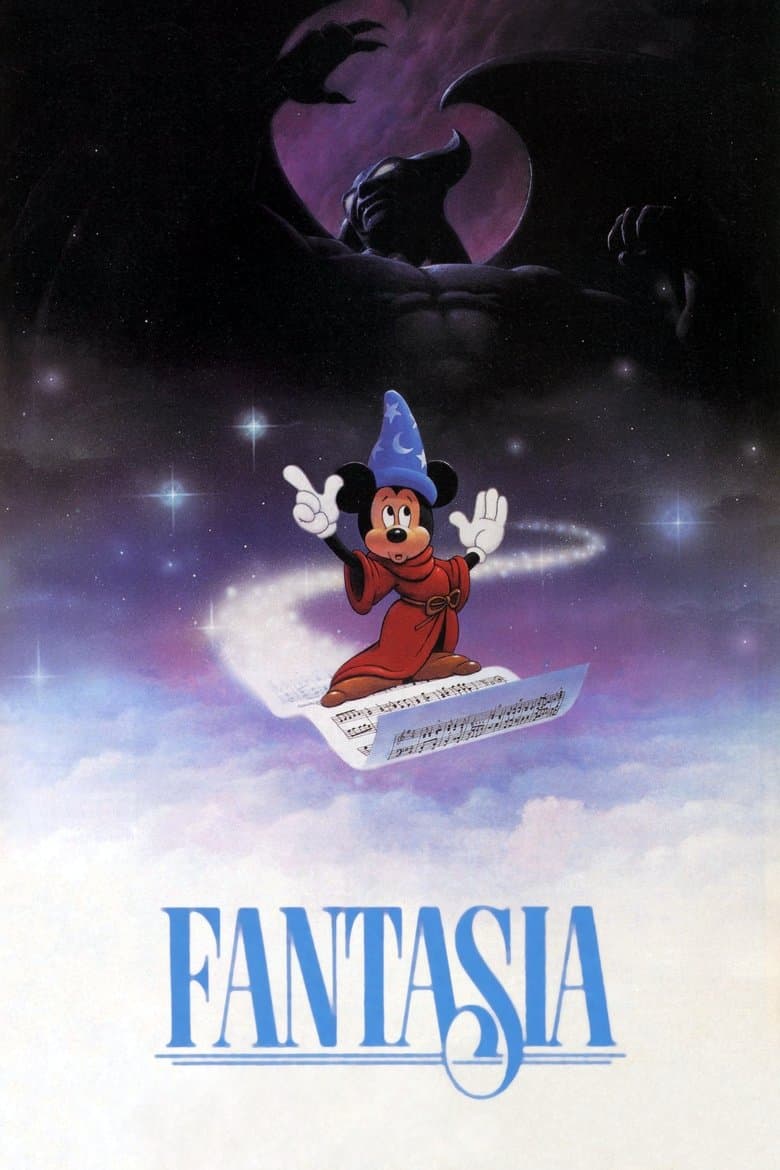
Walt Disney’s ambitious animated experiment pairs classical music with a series of imaginative visual interpretations, creating one of the boldest works in studio-era animation. Rather than telling a single story, the film unfolds through distinct segments that range from abstract patterns and comic fantasy to mythological spectacle and supernatural terror. Conducted by Leopold Stokowski and performed by the Philadelphia Orchestra, the music serves as the film’s true narrative engine, shaping rhythm, mood, and movement in every sequence. From Mickey Mouse in The Sorcerer’s Apprentice to the overwhelming power of Night on Bald Mountain, Fantasia remains a landmark attempt to unite animation, sound, and fine art on a feature-length scale.
Watch for
- How each segment uses movement, color, and design differently, allowing the animation style to change in response to the personality of the music.
- The Sorcerer’s Apprentice sequence, where Mickey’s comic performance and escalating visual invention create one of Disney’s most iconic animated set pieces.
- The contrast between the film’s playful sections and its darker, more abstract or mythic passages, especially in Night on Bald Mountain and Ave Maria.
- The way rhythm drives everything—editing, character motion, visual transformation, and mood—making the film feel choreographed directly from the score.
Production notes
Fantasia was Walt Disney's third feature-length animated film — an ambitious experimental work that married classical music with extended animated sequences. The film grew out of Disney's earlier 'Silly Symphonies' theatrical shorts and was originally conceived as just one such short featuring 'The Sorcerer's Apprentice,' which had ballooned in budget. To recoup the costs, Disney expanded the project into a multi-segment feature combining the Mickey Mouse-starring 'Sorcerer's Apprentice' with seven additional segments — each set to a different classical music piece performed by Leopold Stokowski and the Philadelphia Orchestra. The film required developing an entirely new sound-reproduction technology called 'Fantasound,' an early stereoscopic system that required theaters to install special speaker equipment. The animation was supervised by Ben Sharpsteen, with sequence directors including Samuel Armstrong, Wilfred Jackson, James Algar, and Hamilton Luske. Music supervision was handled by Edward H. Plumb. Production took approximately three years. Production cost approximately $2.28 million.
Trivia
- Fantasia required developing an entirely new sound-reproduction technology called 'Fantasound' — an early stereoscopic system that required theaters to install special speaker equipment; the high cost of the equipment limited the film's initial theatrical reach and contributed to its commercial underperformance.
- The film was a commercial disappointment on its initial 1940 release — partly because of the technical demands of Fantasound, partly because European war markets had been disrupted, and partly because audiences weren't yet prepared for the experimental hybrid form; Disney didn't recover the production costs until the 1969 re-release.
- The original eight-segment film included a 'Pastoral Symphony' sequence featuring a Black centaurette named Sunflower who has been depicted in offensive stereotypical fashion; Sunflower has been edited out of subsequent re-releases, and Disney has formally apologized for the original depiction.
- Stravinsky's 'The Rite of Spring' was the only segment whose source composer was still alive at the time of production; Stravinsky reportedly disliked the Disney version of his music, which had been substantially rearranged and reorchestrated by Stokowski for the film.
- Walt Disney's 1990 Fantasia/2000 sequel — released sixty years after the original — was a long-developed project Walt Disney had originally envisioned as an annual update; the sequel did not achieve substantial commercial success, but it confirmed the original's status as a unique cultural object.
Legacy
Fantasia was a commercial disappointment on its initial 1940 release but has aged into one of the most thoroughly respected animated films in American cinema. It was selected for the inaugural class of the National Film Registry in 1990. The film's experimental hybrid form — combining classical music with extended animated sequences in a multi-segment feature — has remained unique in American studio filmmaking; no subsequent animation house has attempted anything quite comparable. The 'Sorcerer's Apprentice' sequence has become one of the most-referenced animated segments in cinema, with Mickey Mouse as the sorcerer's apprentice becoming permanent shorthand for ambition exceeding ability. The film's 1969 re-release — coinciding with the late-1960s drug-counterculture moment — brought it substantial cult following, and Fantasia became one of the most popular 'head film' (psychedelic viewing) of the era. The 1990 sequel Fantasia 2000 was a long-developed project Walt Disney had originally envisioned as an annual update; the sequel did not achieve substantial commercial success, but it confirmed the original's status as a unique cultural object.