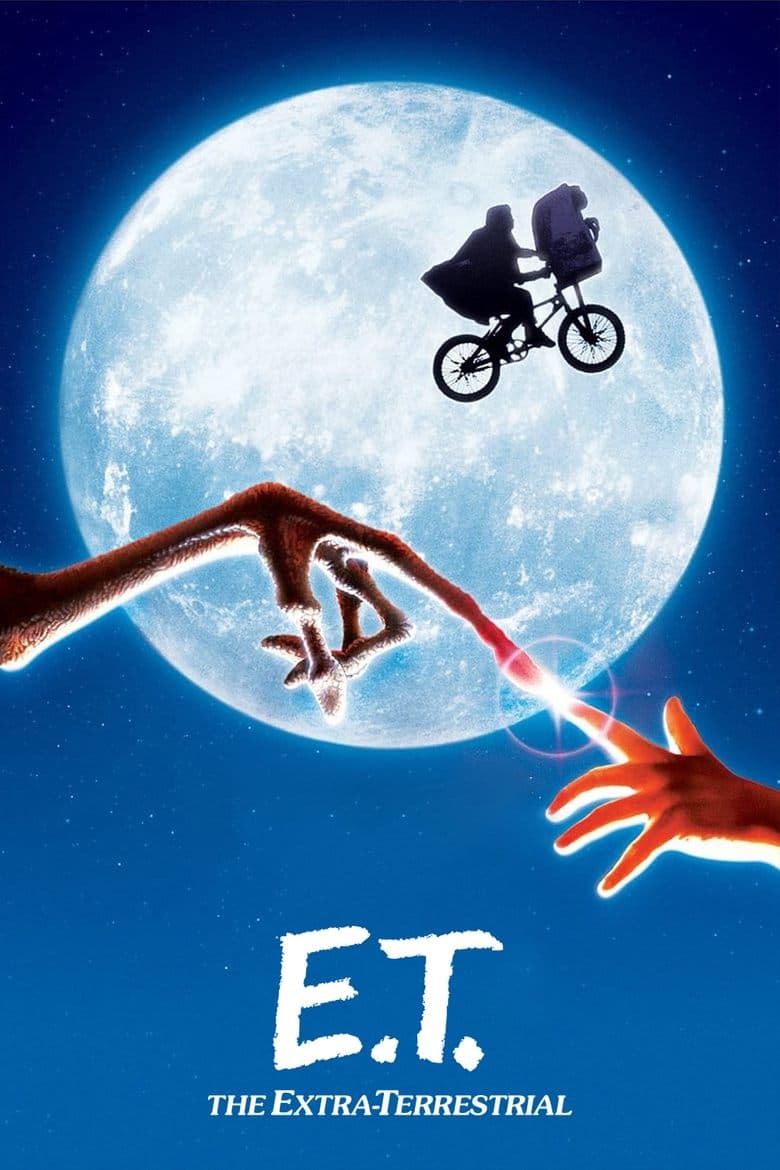
E.T. the Extra-Terrestrial
Vibe
Steven Spielberg’s beloved science fiction fantasy follows Elliott, a lonely suburban boy who discovers and befriends a gentle alien accidentally left behind on Earth. As Elliott and his siblings hide the creature from curious adults and government agents, they form a powerful emotional bond while searching for a way to help E.T. return home. Spielberg tells the story largely from a child’s perspective, blending wonder, humor, and heartfelt emotion. John Williams’s soaring score and the iconic bicycle flight sequence became some of the most recognizable moments in modern cinema. With its themes of friendship, empathy, and belonging, E.T. the Extra-Terrestrial remains one of the most cherished family films ever made.
Watch for
- The famous bicycle flight scene silhouetted against the moon, one of the most iconic images in film history.
- John Williams’s emotional score, which builds the film’s sense of wonder and emotional release.
- The way Spielberg films many scenes from a child’s eye level, emphasizing the story’s perspective.
- Quiet moments between Elliott and E.T. that reveal their growing emotional connection.
Production notes
E.T. the Extra-Terrestrial was Steven Spielberg's deeply personal project — the director has said the film grew from his processing of his parents' 1966 divorce and from an imaginary friend he had as a child during the period of family upheaval. Melissa Mathison wrote the screenplay; Mathison had been the partner of Harrison Ford during Raiders of the Lost Ark's production, where Spielberg had met her. The cast was unusually young: Henry Thomas (10) played Elliott, Drew Barrymore (6) played Gertie, and Robert MacNaughton (15) played Michael. Dee Wallace played their mother Mary. The E.T. creature was a complex puppetry creation by Carlo Rambaldi (who had also created the alien for Close Encounters of the Third Kind); the production used multiple full-size puppets, a smaller stunt-double mechanical version, and dwarf actors in suits for the running shots. Cinematographer Allen Daviau shot the film at deliberately low camera heights to maintain a child's perspective. Composer John Williams contributed the iconic score. Production cost approximately $10.5 million.
Trivia
- The film's iconic flying-bicycle silhouette against a full moon — used as the Amblin Entertainment company logo — has become one of the most recognized brand images in entertainment history; Spielberg founded Amblin partly to expand his production work and chose the E.T. silhouette as the company's symbol.
- Henry Thomas's audition for the role of Elliott has become Hollywood folklore — he was asked to imagine his pet had just died, and his reportedly crying performance reduced Spielberg himself to tears; Thomas was hired immediately, with Spielberg saying simply 'Okay kid, you got the job.'
- Drew Barrymore was 6 when she played Gertie, and the production was reportedly a deeply formative period for her — she has spoken of E.T. (the puppet) as her childhood friend, and the experience and her subsequent young-Hollywood difficulties have been documented in her 1990 memoir Little Girl Lost.
- The famous candy product placement — Reese's Pieces, used to lure E.T. with a trail — was originally going to be M&Ms; the M&M company refused the placement, fearing the alien would scare children, and Reese's accepted the placement instead, with their candy sales reportedly tripling within weeks of the film's release.
- E.T. became the highest-grossing film of all time on its 1982 release, earning approximately $359 million domestically (over $792 million worldwide) and surpassing Star Wars; it held the highest-grossing-film title until Jurassic Park surpassed it in 1993.
Legacy
E.T. the Extra-Terrestrial received nine Academy Award nominations and won four (Best Original Score, Best Sound, Best Sound Effects Editing, Best Visual Effects); it was famously denied Best Picture, which went to Gandhi. The film was selected for the National Film Registry in 1994. Its $359 million domestic gross made it the highest-grossing film of all time on initial release, a title it held until Jurassic Park surpassed it in 1993. The film's central image — a flying bicycle silhouetted against a full moon — became the Amblin Entertainment logo and one of the most recognized brand images in entertainment history. The film's emotional reach has been continuous: subsequent generations of children have discovered it on television and home video, and its central narrative (child befriending alien against parental absence and childhood loneliness) has aged into permanent American cinematic mythology. The 1985 sequel was developed but never produced; the 2002 20th anniversary theatrical re-release reintroduced the film to a new generation. Among Spielberg's films, E.T. is the most thoroughly personal and the one that most completely captures his unique vision of childhood wonder.