Doctor Zhivago
Vibe
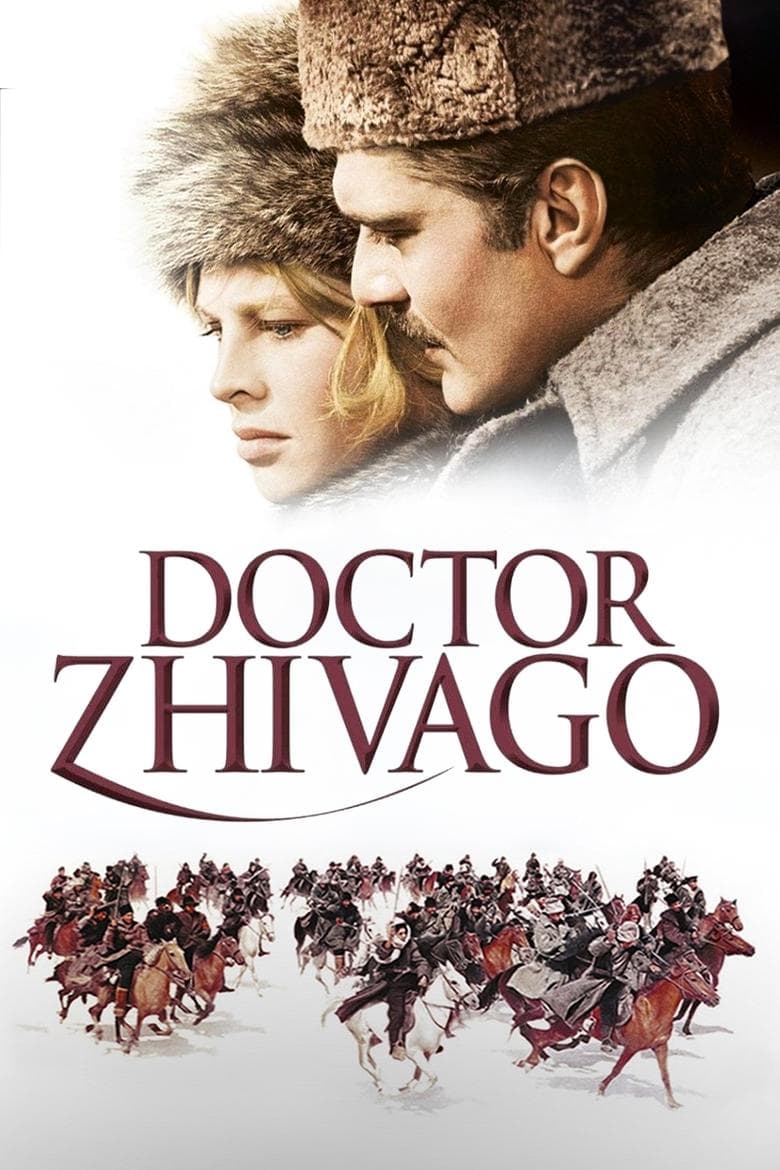
David Lean’s sweeping historical romance unfolds against the upheaval of the Russian Revolution and its aftermath. The film follows Yuri Zhivago, a physician and poet whose life is torn apart by war, political turmoil, and his enduring love for Lara. As the old social order collapses and a new one rises in its place, Yuri struggles to preserve his humanity, artistic spirit, and personal loyalties amid forces far larger than himself. Omar Sharif and Julie Christie bring emotional depth to the film’s central romance, while Lean’s grand visual style captures both the beauty and devastation of a nation in transformation. With its epic scope and Maurice Jarre’s unforgettable “Lara’s Theme,” Doctor Zhivago remains one of cinema’s most memorable romantic epics.
Watch for
- Lean’s use of vast landscapes, wintry interiors, and carefully composed widescreen images to contrast private emotion with historical upheaval.
- The recurring power of “Lara’s Theme,” which binds memory, longing, and loss throughout the film.
- How Omar Sharif plays Zhivago as an observer caught between duty, desire, and the violent sweep of history.
- The film’s shifts between intimate love story and large-scale historical tableau, which give the romance its sense of fragility and inevitability.
Production notes
Doctor Zhivago was David Lean's adaptation of Boris Pasternak's 1957 novel, with the screenplay by Robert Bolt (continuing his Lean collaboration after Lawrence of Arabia). The Soviet government had banned Pasternak's novel and refused permission to film in Russia; the production was shot primarily in Spain, with the snow-covered Russian-countryside sequences shot in winter Madrid suburbs and the summer-Russia sequences in Soria province. Omar Sharif played Yuri Zhivago, with Julie Christie as Lara, Geraldine Chaplin as Tonya, Tom Courtenay as Pasha, Rod Steiger as Komarovsky, Alec Guinness as Yevgraf, and Ralph Richardson as Tonya's father Alexander Gromeko. Cinematographer Freddie Young (continuing his Lean collaboration) shot the film in 70mm Super Panavision and won his second Academy Award for the work. Composer Maurice Jarre contributed the iconic score, with 'Lara's Theme' becoming one of the most recognizable pieces of film music ever composed. Production took approximately ten months and cost approximately $11 million.
Trivia
- The Soviet government had banned Boris Pasternak's source novel and refused permission to film in Russia; the production was shot primarily in Spain, with snow-covered Russian-countryside sequences shot in winter Madrid suburbs and summer-Russia sequences in Soria province.
- Boris Pasternak's novel had won the 1958 Nobel Prize in Literature, but the Soviet government had pressured Pasternak to decline the prize; Pasternak had complied with the demand, and his subsequent literary career was effectively destroyed before his 1960 death — five years before the film adaptation appeared.
- Maurice Jarre's iconic 'Lara's Theme' was reportedly written under enormous time pressure as a last-minute addition; David Lean had wanted a different musical approach and the theme was developed during late post-production, becoming one of the most recognizable pieces of film music ever composed and a Top 10 single in the U.S. on its release.
- Doctor Zhivago grossed approximately $200 million worldwide on its initial release, becoming one of the highest-grossing films of the 1960s; adjusted for inflation, the film remains one of the highest-grossing films in domestic American box-office history.
- The film received ten Academy Award nominations and won five — Best Adapted Screenplay (Robert Bolt), Best Cinematography (Freddie Young), Best Original Score (Maurice Jarre), Best Costume Design, and Best Art Direction; it lost Best Picture and Best Director to The Sound of Music in one of the more contested years of the mid-1960s.
Legacy
Doctor Zhivago was a massive commercial success, grossing approximately $200 million worldwide on its initial release and becoming one of the highest-grossing films of the 1960s. It won five Academy Awards (on ten nominations) and was selected for the National Film Registry in 1998. Maurice Jarre's 'Lara's Theme' became one of the most recognizable pieces of film music ever composed, a Top 10 single on the U.S. Billboard charts and a permanent fixture of romantic-orchestral music in popular culture. The film's depiction of revolutionary Russia — its sweeping winter vistas, its tragic love story playing out against political upheaval — gave American cinema one of its most ambitious treatments of twentieth-century European political crisis. Among David Lean's epic-romantic films, Doctor Zhivago sits alongside Lawrence of Arabia (1962) and A Passage to India (1984) as the high-water marks of his late-career style. The 1980s and 1990s critical reassessment treated the film with somewhat more skepticism than its contemporary reception had — questions about its political simplifications, its romantic-melodramatic structure — but its commercial reach and musical legacy have remained extraordinary.