Dances with Wolves
Vibe
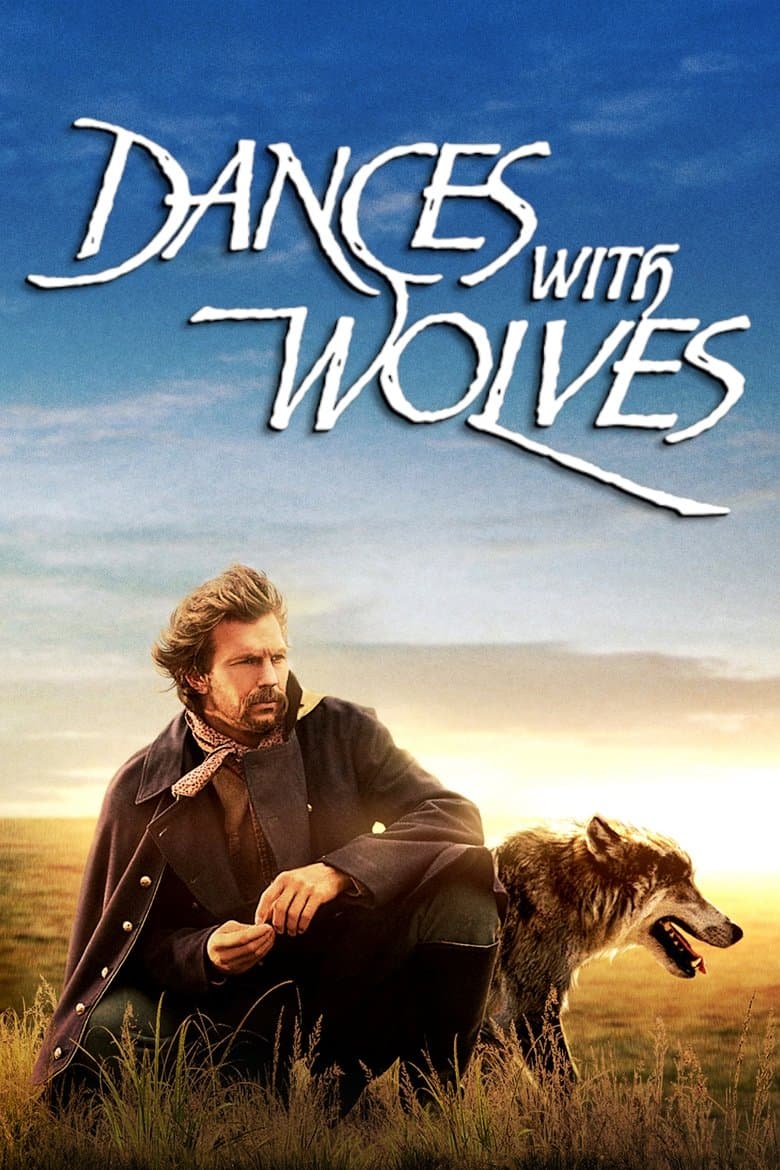
Kevin Costner’s sweeping Western follows Union Army lieutenant John Dunbar, who takes an isolated frontier posting and gradually forges a bond with a nearby Lakota Sioux community. As Dunbar learns their language, customs, and way of life, his understanding of the frontier—and of himself—begins to change. Costner’s direction emphasizes the vast beauty of the plains while treating cultural encounter with unusual patience and seriousness. Notable for its use of the Lakota language and its more respectful portrayal of Indigenous characters than many earlier Hollywood Westerns, the film blends adventure, history, and spiritual transformation. Dances with Wolves became one of the defining Westerns of modern American cinema.
Watch for
- How the wide-open landscapes are used not just for spectacle, but to reflect Dunbar’s isolation, wonder, and gradual sense of belonging.
- The slow evolution of trust between Dunbar and the Lakota, which gives the film its emotional center and much of its quiet power.
- John Barry’s score, which adds a lyrical, elegiac quality that helps frame the story as both adventure and farewell to a disappearing world.
- The contrast between Dunbar’s growing connection to the Lakota community and the destructive force of the U.S. military presence closing in around him.
Production notes
Dances with Wolves was Kevin Costner's directorial debut, adapted by Michael Blake from his own 1988 novel. Costner had developed the project for years, financing the production substantially from his own resources after Hollywood studios had passed on the proposal — the film was widely considered too risky given its three-hour running time, substantial Lakota-language dialogue, and first-time director's involvement. Costner himself played Lieutenant John J. Dunbar, the Union Army officer who is sent to a remote western frontier outpost during the U.S. Civil War and who gradually develops a profound relationship with the Lakota people of the surrounding territory. The cast included Mary McDonnell as Stands With A Fist (a white woman raised by the Lakota), Graham Greene as Kicking Bird, Rodney A. Grant as Wind In His Hair, Floyd Red Crow Westerman as Ten Bears, Tantoo Cardinal as Black Shawl, and Robert Pastorelli as Timmons. The film's extensive Lakota-language dialogue — with subtitles for English-speaking audiences — was an unprecedented commitment by a major Hollywood production. Cinematographer Dean Semler shot the film. Composer John Barry contributed the score. Production cost approximately $22 million.
Trivia
- Kevin Costner financed substantial portions of the production himself after Hollywood studios had passed on the proposal, considering the film too risky given its three-hour running time, substantial Lakota-language dialogue (with English subtitles), and first-time director involvement; Costner's personal financial commitment was reportedly approximately $3 million of his own money.
- The film's extensive Lakota-language dialogue — with subtitles for English-speaking audiences — was an unprecedented commitment by a major Hollywood production; Native American activists and academics worked extensively with the production to ensure authentic linguistic and cultural representation, though some contemporary critics have argued the film still rests on white-savior narrative conventions.
- Graham Greene's performance as Kicking Bird earned him the Academy Award nomination for Best Supporting Actor; Greene became one of the few Native American actors to receive an Oscar nomination, and the recognition opened the way to his subsequent decade-long career in major Hollywood productions including Thunderheart (1992) and Maverick (1994).
- Dances with Wolves won seven Academy Awards including Best Picture, Best Director (Kevin Costner, in his debut), Best Adapted Screenplay (Michael Blake), Best Cinematography (Dean Semler), Best Film Editing, Best Original Score (John Barry), and Best Sound; the win has been continuously discussed as a controversial Best Picture decision, with Goodfellas considered by many critics the stronger contender.
- The film grossed approximately $424 million worldwide on its $22 million budget — making it one of the most thoroughly commercially successful prestige westerns ever produced; the success effectively launched a brief revival of the western genre that included Unforgiven (1992) and Tombstone (1993).
Legacy
Dances with Wolves won seven Academy Awards including Best Picture, Best Director (Costner's directorial debut), and Best Adapted Screenplay. It grossed approximately $424 million worldwide on its $22 million budget. It was selected for the National Film Registry in 2007. The film's Best Picture win has been continuously discussed as a controversial decision, with many critics considering Goodfellas the stronger 1990 contender; the win was widely seen as Hollywood's delayed recognition of the western genre's mainstream legitimacy. The film's specific approach to Native American representation — extensive Lakota-language dialogue with subtitles, native actors in leading supporting roles, cultural-consultant involvement throughout production — was unprecedented for a major Hollywood production and helped open the way to subsequent Native American representation work. Some contemporary critics have argued the film still rests on white-savior narrative conventions, with the central character's role as the bridge between cultures problematic from a post-colonial perspective. The film triggered a brief revival of the prestige western genre, with Unforgiven (1992) and Tombstone (1993) following in its wake.