City Lights
Vibe
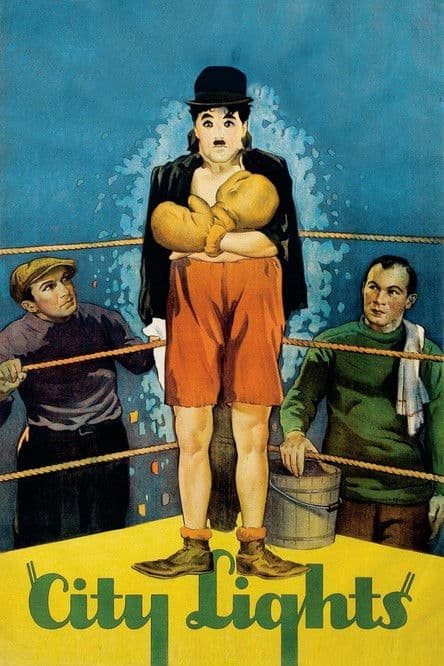
Charlie Chaplin’s beloved silent masterpiece follows the Little Tramp as he falls in love with a blind flower girl who mistakes him for a wealthy gentleman. Moved by her kindness and determined to help her regain her sight, he embarks on a series of comic misadventures to earn the money for an operation. Chaplin balances slapstick precision with extraordinary tenderness, turning the Tramp’s devotion into both a source of laughter and quiet heartbreak. Released after sound had already transformed the industry, City Lights stood as a radiant defense of silent cinema’s expressive power. It remains one of Chaplin’s most celebrated achievements and one of the most emotionally resonant films ever made.
Watch for
- Chaplin’s precise physical comedy, especially in the boxing sequence, where rhythm, space, and movement create a virtuoso display of silent-era comic timing.
- The contrast between the Tramp’s social invisibility and the flower girl’s idealized perception of him, which gives the film both its humor and its aching emotional core.
- How Chaplin uses the recurring millionaire character to pivot between fantasy, farce, and the Tramp’s precarious dependence on chance.
- The final reunion scene, where tiny expressions and gestures carry overwhelming emotional weight without the need for dialogue.
Production notes
City Lights was Charlie Chaplin's silent romantic comedy — produced and released in 1931, fully four years after the 1927 release of The Jazz Singer had effectively ended Hollywood's silent era. Chaplin's commitment to silent filmmaking against the industry's dominant trend was a deliberate aesthetic choice; he believed his Tramp character's appeal depended on pantomime rather than dialogue, and the production became an extended experiment in late-silent-era filmmaking. The film tells the story of the Tramp's romance with a blind flower-seller and his friendship with a wealthy alcoholic millionaire whose moods determine the Tramp's social fortunes. Chaplin wrote, produced, directed, scored, and starred. Virginia Cherrill played the blind flower girl, with Harry Myers as the millionaire and Florence Lee as the blind girl's grandmother. The famous closing scene — the Tramp's wordless reunion with the now-sighted flower girl, played in extended close-ups of both characters' faces — has been continuously celebrated as one of the great moments in any cinema. Cinematographer Roland Totheroh shot the film. Production cost approximately $1.6 million.
Trivia
- Charlie Chaplin's commitment to silent filmmaking with City Lights was a deliberate aesthetic choice against the dominant industry trend — the film was released four years after The Jazz Singer (1927) had effectively ended Hollywood's silent era; Chaplin believed his Tramp character's appeal depended on pantomime rather than dialogue.
- Chaplin himself composed the film's score — his first credit as composer — and the resulting music has been widely celebrated as one of the most thoroughly realized silent-film scores in cinema; Chaplin's score work would continue through his subsequent films, with Modern Times (1936) and The Great Dictator (1940).
- The famous closing scene — the Tramp's wordless reunion with the now-sighted flower girl — was shot in extended close-ups of both characters' faces; the sequence reportedly required approximately 342 takes to complete, with Chaplin demanding perfection from Virginia Cherrill's reaction throughout.
- Albert Einstein attended the film's January 1931 Los Angeles premiere as Chaplin's personal guest; the meeting and subsequent friendship between Chaplin and Einstein generated substantial press attention, and Einstein reportedly told Chaplin that night that he was 'one of the great men of our time' for his ability to communicate across all language boundaries.
- City Lights was a substantial commercial success on its 1931 release despite the industry's overwhelming shift to sound; the film grossed approximately $5 million worldwide, demonstrating that Chaplin's silent-era commercial appeal had survived the technological transition.
Legacy
City Lights is widely considered Charlie Chaplin's masterpiece and one of the great romantic comedies of any cinema. It was selected for the inaugural class of the National Film Registry in 1991. The famous closing scene — the Tramp's wordless reunion with the now-sighted flower girl — has been continuously celebrated as one of the great moments in any cinema, regularly cited as one of the most emotionally powerful sequences ever filmed. Sight & Sound's decennial critics' polls have consistently placed City Lights among the greatest films ever made. The film's commercial success on its 1931 release demonstrated that Chaplin's silent-era appeal had survived the industry's overwhelming shift to sound, and helped establish his ability to operate as a Hollywood outsider — producing his own films on his own creative terms across the next two decades. Chaplin's score for City Lights was his first credit as composer and helped establish the integrated-music-with-physical-comedy approach that would continue through Modern Times (1936) and The Great Dictator (1940). Among Chaplin's films, City Lights sits alongside The Gold Rush (1925) and Modern Times (1936) as the canonical achievements of his Tramp era.