Citizen Kane
Vibe
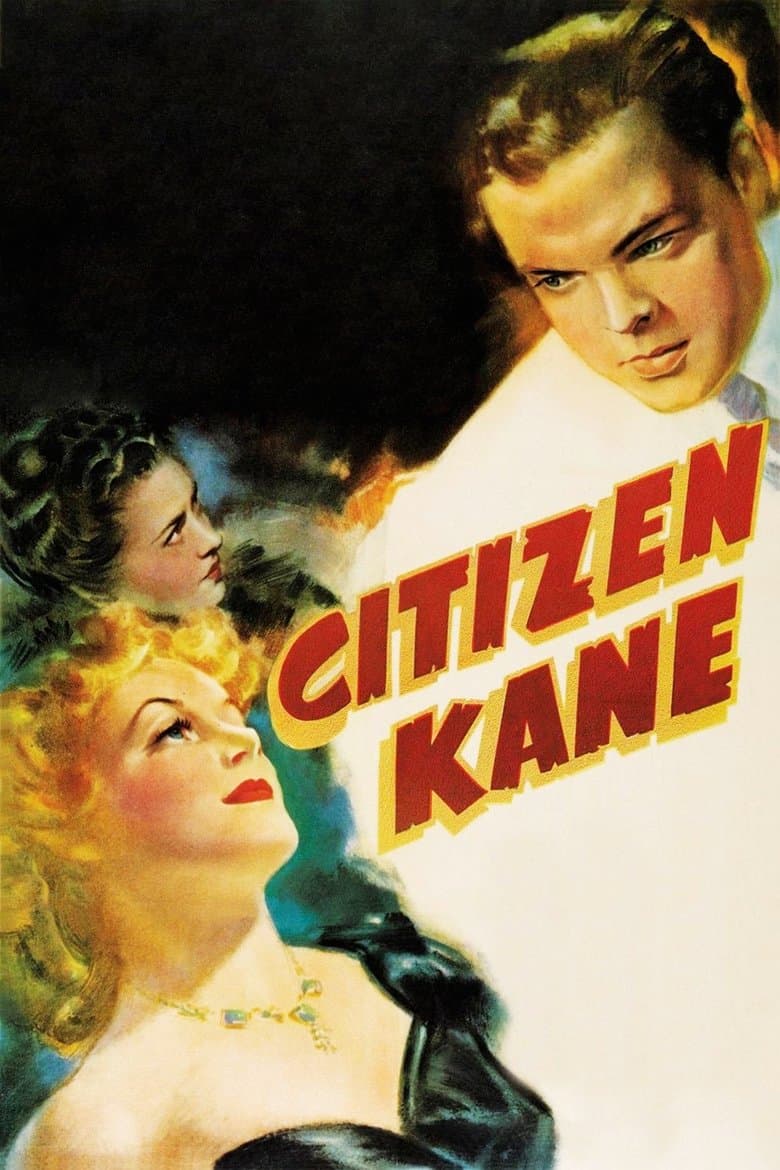
Orson Welles’s bold directorial debut begins with the death of newspaper tycoon Charles Foster Kane and the mystery of his final word: “Rosebud.” A reporter interviews the people who knew Kane—friends, business partners, and former lovers—gradually piecing together the life of a man who rose from humble beginnings to immense wealth and influence. Each perspective reveals a different version of Kane, from idealistic young publisher to powerful but deeply isolated figure. Working with cinematographer Gregg Toland, Welles introduced striking innovations in filmmaking, including deep-focus photography, dramatic low-angle compositions, and a nonlinear narrative built from memory and testimony. Though controversial on release and only a modest box-office success, Citizen Kane later became widely regarded as one of the most influential films in cinema history.
Watch for
- Deep-focus compositions where multiple planes of action remain sharp, allowing scenes to unfold visually without cutting.
- Low-angle camera shots that emphasize Kane’s growing power and dominance within a frame.
- Narrative structure through memory: each witness reveals a partial truth, leaving the audience to assemble Kane’s life like a puzzle.
- Visual storytelling and transitions, including dissolves, sound bridges, and montage sequences that compress years of Kane’s life into moments.
Production notes
Citizen Kane was Orson Welles's debut feature, made under an unprecedented RKO contract that gave the 25-year-old radio and theater prodigy near-total creative control: final cut, choice of crew, freedom from studio interference. Welles co-wrote the screenplay with Herman J. Mankiewicz, whose role in shaping the script — and whose authorship — has remained a critical battleground ever since Pauline Kael's 1971 essay 'Raising Kane.' The film's deep-focus photography was the work of Gregg Toland, who approached Welles asking to shoot the project; Toland's innovations included specially coated lenses, ceilinged sets to allow low-angle shots, and split-focus diopters that kept foreground and background simultaneously sharp. Bernard Herrmann composed his first feature score. The film's portrait of Kane was widely understood as a thinly fictionalized attack on William Randolph Hearst, who used his newspaper empire to suppress the film's promotion. Production cost approximately $840,000.
Trivia
- William Randolph Hearst, the newspaper magnate who recognized himself as the basis for Kane, mobilized his entire media empire against the film — banning advertising, refusing to review it, threatening theater chains, and reportedly offering RKO $800,000 to destroy the negative.
- Citizen Kane received nine Academy Award nominations but won only one — Best Original Screenplay, for Welles and Mankiewicz; the wins were widely attributed to Hearst's pressure campaign and the film's commercial underperformance on initial release.
- Welles was 25 when he directed the film, making him the youngest filmmaker ever to receive a Best Director Oscar nomination at the time; he would not direct another studio feature with comparable creative freedom for the rest of his career.
- The mystery word 'Rosebud' was reportedly inspired by Hearst's private nickname for an intimate part of his mistress Marion Davies's anatomy — a detail Mankiewicz had learned during his time as a Hearst guest at San Simeon.
- Cinematographer Gregg Toland insisted on his own credit appearing on the same title card as Welles's directing credit — an unprecedented honor for a cinematographer that signaled the film's deliberate elevation of visual authorship to equal status with directorial vision.
Legacy
Citizen Kane's reputation has only grown in the decades since its modest 1941 box-office reception. Sight & Sound's decennial poll of international film critics named it the greatest film ever made in every poll from 1962 through 2002 — a fifty-year reign unprecedented in film criticism — before Vertigo displaced it in 2012. The film was selected for the inaugural class of the National Film Registry in 1989. Its formal innovations — deep-focus cinematography, fragmented narrative structure told through flashbacks and multiple unreliable narrators, sound bridges and montage compression of decades into minutes — became foundational vocabulary for the New Hollywood generation of the 1970s and remain part of every film school curriculum. The film's portrait of media power, wealth, and personal isolation has aged into prophetic resonance during the contemporary era of billionaire-owned media. Critics from François Truffaut to Roger Ebert have written extensively about the film. Kane's cultural shadow now extends across nearly every serious treatment of American power and media influence in cinema since.