Bringing Up Baby
Vibe
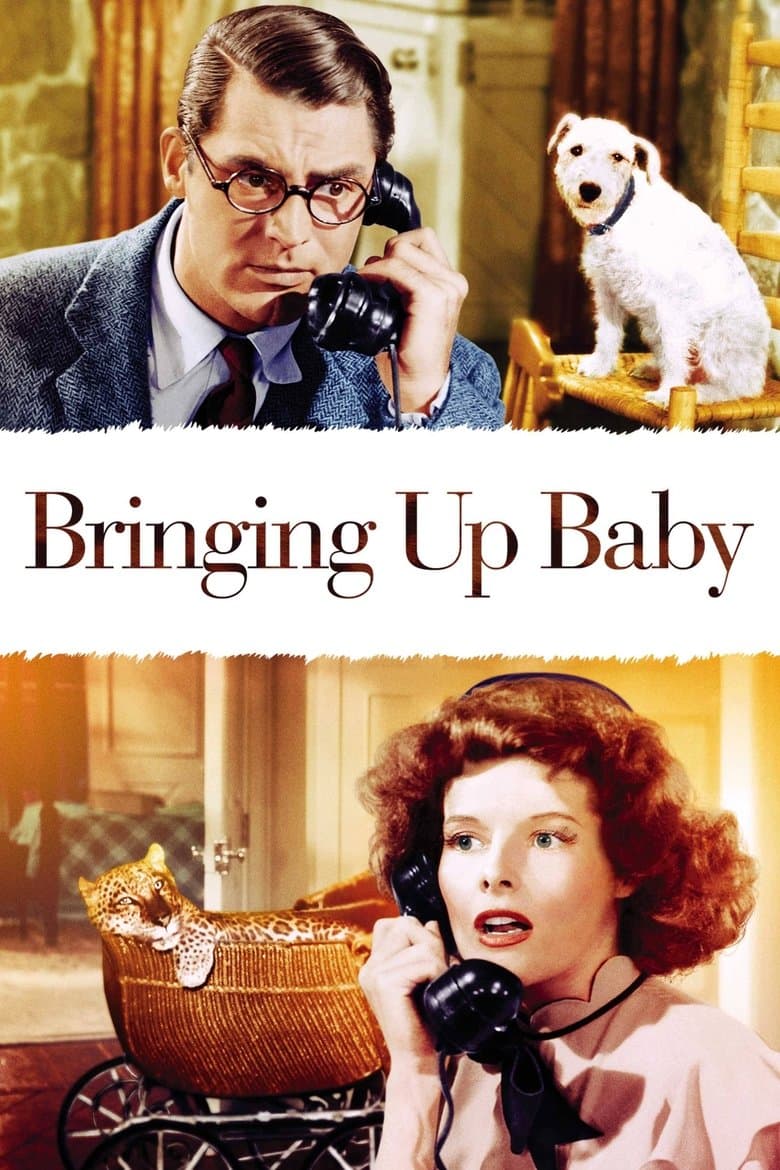
Howard Hawks’s fast-paced screwball comedy throws mild-mannered paleontologist David Huxley into the orbit of Susan Vance, an impulsive heiress whose chaotic energy overturns every attempt at order in his carefully managed life. What begins as a professional errand involving a museum donation spirals into a delirious chain of misunderstandings, missing bones, jail cells, and a tame leopard named Baby. Cary Grant and Katharine Hepburn generate dazzling comic momentum through timing, exasperation, and romantic friction, while Hawks keeps the farce moving with astonishing speed and precision. Initially overlooked, Bringing Up Baby later came to be recognized as one of the great screwball comedies and one of Hollywood’s purest comic machines.
Watch for
- Cary Grant’s physical and verbal comedy, especially the way David’s dignity disintegrates scene by scene into panic, confusion, and helpless attraction.
- Katharine Hepburn’s performance as Susan, whose relentless confidence and cheerful unpredictability make her both the engine of the farce and the film’s comic destabilizer.
- How Hawks sustains escalating chaos through pacing, overlapping complications, and perfectly timed entrances, exits, and reversals.
- The contrast between David’s world of scientific order and Susan’s world of impulse and disruption, which turns romance into a battle between control and surrender.
Production notes
Bringing Up Baby was Howard Hawks's screwball comedy starring Cary Grant as the bumbling paleontologist David Huxley and Katharine Hepburn as the wealthy heiress Susan Vance who becomes romantically obsessed with him — and disrupts his life through a series of increasingly chaotic encounters involving a tame leopard named Baby (the title character). The screenplay was credited to Hagar Wilde and Dudley Nichols, based on Wilde's earlier Collier's magazine story. The film was RKO Radio Pictures's prestige comedy production, with substantial budget allocation for set construction, animal work (the leopard sequences required substantial trained-animal coordination), and the chaotic comic-action sequences that became central to the film's character. The cast included Charles Ruggles as Major Horace Applegate, Walter Catlett as Constable Slocum, Barry Fitzgerald as the gardener Aloysius Gogarty, May Robson as Susan's aunt Mrs. Random, Fritz Feld as Dr. Lehman, and Asta (the wire fox terrier who had also appeared in The Thin Man series) as George the dog. Cinematographer Russell Metty shot the film. Composer Roy Webb contributed the score. Production cost approximately $1 million.
Trivia
- Bringing Up Baby was a commercial disappointment on its 1938 release — losing money for RKO Radio Pictures and contributing to Howard Hawks's brief commercial decline; Katharine Hepburn was contemporaneously labeled 'box-office poison' by Hollywood, and her career would not fully recover until her 1940 work in The Philadelphia Story.
- Katharine Hepburn's substantial physical-comedy work in the film — including the famous tornness-dress sequence and the leopard-chase scenes — required substantial trained-animal coordination; Hepburn reportedly performed many sequences in close proximity to the actual tame leopard, with handlers continuously present off-screen.
- The famous 'I just went gay all of a sudden!' line — uttered by Cary Grant's character when he's caught wearing women's clothing — has been continuously cited as one of the earliest mainstream Hollywood uses of the word 'gay' in its contemporary sexual-identity sense; the line's specific meaning in 1938 has been debated, but the line's continuing presence in cultural reception is substantial.
- Howard Hawks's substantial collaboration with Cary Grant — Bringing Up Baby was the first of approximately four major Cary Grant-Howard Hawks collaborations (with His Girl Friday in 1940, I Was a Male War Bride in 1949, and Monkey Business in 1952) — established Grant as one of Hawks's preferred leading men and helped shape Grant's subsequent decade of screwball-comedy work.
- Bringing Up Baby has aged into one of the most thoroughly respected American screwball comedies, despite its commercial disappointment on initial release; subsequent decades of critical reassessment have substantially elevated the film's status, and contemporary critics regularly cite it as Howard Hawks's masterpiece.
Legacy
Bringing Up Baby was a commercial disappointment on its 1938 release but has aged into one of the most thoroughly respected American screwball comedies and is regularly cited as Howard Hawks's masterpiece. It received no Academy Award nominations on its 1938 release. It was selected for the National Film Registry in 1990. The film's substantial influence on subsequent screwball-comedy work has been continuous — Peter Bogdanovich's What's Up, Doc? (1972) was an explicit homage starring Barbra Streisand and Ryan O'Neal in the Hepburn-Grant roles, and the screwball-comedy template established by Bringing Up Baby has shaped subsequent decades of romantic-comedy work from Romancing the Stone (1984) to While You Were Sleeping (1995). The famous 'I just went gay all of a sudden!' line has been continuously cited as one of the earliest mainstream Hollywood uses of the word 'gay' in its contemporary sexual-identity sense. Among American screwball comedies of the late 1930s, Bringing Up Baby sits alongside It Happened One Night (1934), My Man Godfrey (1936), and The Philadelphia Story (1940) as the canonical achievements of the form.