The Birth of a Nation
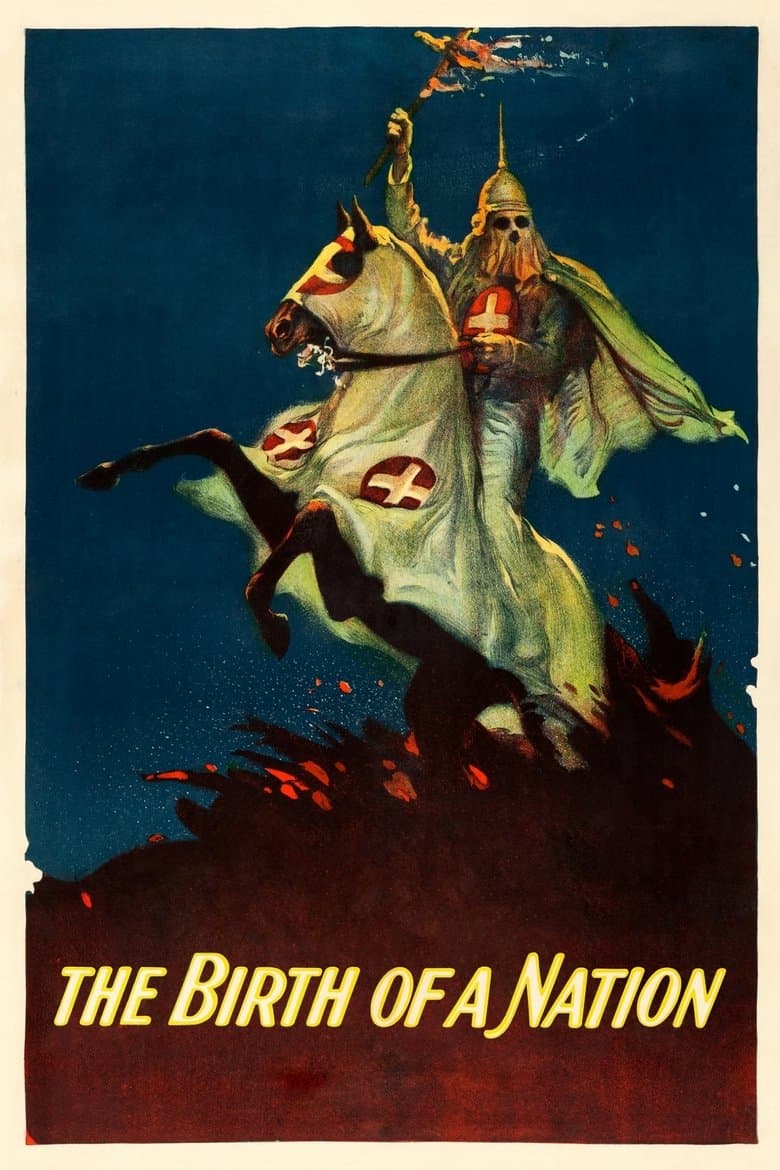
Vibe
D.W. Griffith’s controversial silent epic portrays the American Civil War and Reconstruction through the intertwined stories of two families on opposing sides of the conflict. The film was enormously influential in the development of cinematic language, advancing large-scale battle staging, cross-cutting, close-ups, and feature-length narrative structure in ways that shaped early filmmaking. At the same time, its virulently racist depiction of Black Americans and its glorification of the Ku Klux Klan have made it one of the most condemned works in American film history. The Birth of a Nation endures not as a simple classic, but as a defining example of how technical innovation and harmful ideology can coexist within a single landmark work.
Watch for
- The film’s use of cross-cutting and large-scale staging, which helped define how suspense, action, and parallel storytelling could work in feature filmmaking.
- How Griffith uses close-ups, crowd scenes, and movement within the frame to create emotional intensity and narrative momentum uncommon for its era.
- The ways the film’s technical achievements are intertwined with its racist point of view, making form and ideology impossible to separate.
- How the Reconstruction sequences reveal the film’s distorted historical narrative, offering a crucial example of how cinema can shape public memory as well as entertain.
Production notes
The Birth of a Nation was D.W. Griffith's adaptation of Thomas Dixon Jr.'s 1905 novel The Clansman and 1909 stage play of the same name. Griffith financed the film primarily through equity fundraising — an unusual approach for the era — and produced it independently before securing major distribution. The screenplay was by Griffith and Frank E. Woods. Lillian Gish played Elsie Stoneman, with Mae Marsh as Flora Cameron, Henry B. Walthall as Colonel Ben Cameron, and Ralph Lewis as Austin Stoneman (a fictionalized version of Thaddeus Stevens). The film's three-hour-plus running time was unprecedented for the era — most narrative features at the time ran approximately 60-80 minutes — and Griffith's substantial production scale required developing new approaches to battle-scale staging, location shooting, and parallel editing. Cinematographer G.W. Bitzer shot the film. Composer Joseph Carl Breil contributed the score, with the famous 'Ride of the Valkyries' Wagner adaptation in the Klan-rescue sequence. Production cost approximately $110,000 — an enormous budget for any 1915 film.
Trivia
- The Birth of a Nation was the first feature-length film ever screened at the White House — President Woodrow Wilson, an old friend of source novelist Thomas Dixon Jr., screened it on February 18, 1915 and reportedly described it as 'like writing history with lightning'; Wilson's later accounts disputed making the comment.
- The film generated some of the largest organized public protests against any American film in the silent era; the NAACP, founded in 1909, organized boycotts in major cities and pressured municipal authorities to ban the film, succeeding in some cities (Chicago, Cleveland, parts of Massachusetts) but not nationally.
- The Birth of a Nation's depiction of the Reconstruction-era Ku Klux Klan as heroic was instrumental in the actual revival of the Klan as an organization; William Joseph Simmons explicitly cited the film as inspiration when he refounded the Klan in 1915 at Stone Mountain, Georgia, after watching the film's premiere.
- Griffith reportedly defended the film against accusations of racism — though his defenses were widely considered inadequate at the time — and his subsequent feature Intolerance (1916) was understood as a partial atonement, though Griffith himself never publicly acknowledged the connection.
- The Birth of a Nation grossed approximately $50-100 million in 1915 dollars over its multi-decade theatrical lifetime — making it potentially the highest-grossing American film of the silent era, though precise box-office figures from the era are difficult to verify.
Legacy
The Birth of a Nation occupies one of the most morally fraught positions in American cinema — a film whose technical innovations established much of the visual vocabulary of subsequent American cinema, but whose racist content directly inspired the early-twentieth-century revival of the Ku Klux Klan and contributed to the real-world social damage of subsequent decades. It was selected for the National Film Registry in 1992 — a recognition specifically of the film's technical significance rather than endorsement of its content. The film's 1915 premiere triggered some of the largest organized public protests against any American film in the silent era. The NAACP's campaigns against it became one of the founding organizations' early political mobilizations. Recent critical reassessments have substantially shifted the film's institutional reception — the American Film Institute removed it from its Top 100 list in 2007 — but it remains studied for its technical innovations (parallel editing, battle-scale staging, crosscutting between simultaneous actions) that influenced subsequent decades of American cinema. The film's continuing presence in film-history curricula has been the subject of ongoing pedagogical debate about how to teach a technically influential work whose content was actively destructive.