Ben-Hur
Vibe
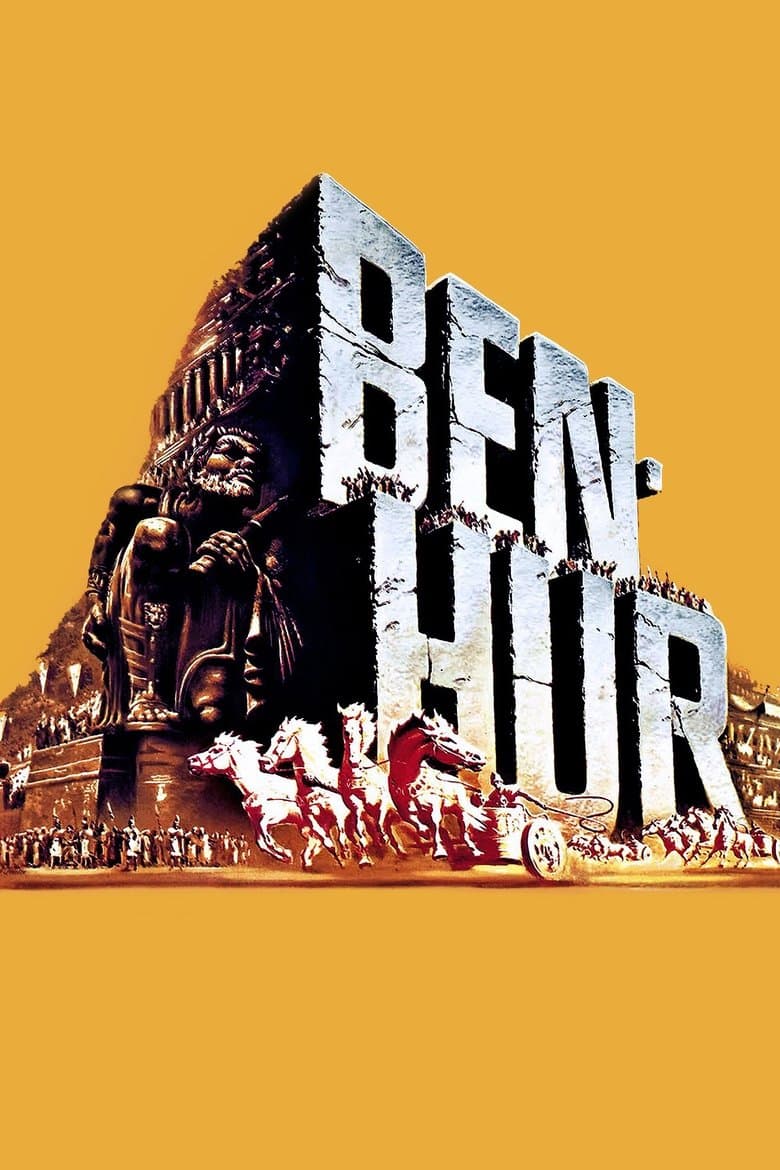
William Wyler’s epic historical drama follows Judah Ben-Hur, a Jewish prince in Roman-occupied Judea whose life is shattered when betrayal by his childhood friend Messala leads to imprisonment, slavery, and the destruction of his family. Driven by anger and the desire for revenge, Judah fights his way back through hardship and humiliation, only to confront larger questions of justice, mercy, and spiritual transformation. Charlton Heston gives the character a commanding physical presence, while Wyler stages the story on a scale that matches its emotional and religious sweep. With its monumental production design and legendary chariot race, Ben-Hur remains one of Hollywood’s defining screen epics.
Watch for
- Wyler’s command of scale, especially the way huge sets, crowds, and processions are balanced with close, emotionally focused scenes between former friends and family members.
- Charlton Heston’s performance, which gradually shifts Judah from proud aristocrat to hardened survivor to a man forced to reconsider vengeance itself.
- The chariot race sequence, where editing, stunt work, and physical space create one of the most thrilling action set pieces in cinema history.
- How the film intertwines Roman political power with spiritual imagery, allowing Judah’s personal story to unfold alongside a larger meditation on faith and transformation.
Production notes
Ben-Hur was William Wyler's adaptation of Lew Wallace's 1880 novel A Tale of the Christ — the second film adaptation of the work (after the 1925 silent Fred Niblo version starring Ramon Novarro). The film was MGM's most ambitious production to date and required approximately three years from initial preparation through release. The screenplay was credited to Karl Tunberg, but extensive uncredited contributions came from S.N. Behrman, Maxwell Anderson, Gore Vidal (who claimed to have introduced the homosexual subtext to the Messala-Judah relationship — a claim Tunberg disputed), and Christopher Fry. Charlton Heston played Judah Ben-Hur — the role established him as the canonical American epic-prestige leading man — with Stephen Boyd as the Roman officer Messala, Jack Hawkins as the Roman Consul Quintus Arrius, Haya Harareet as Esther, Hugh Griffith as the Arab sheik Ilderim, Martha Scott as Miriam, and Cathy O'Donnell as Tirzah. The famous chariot-race sequence — directed by second-unit director Andrew Marton — required approximately six weeks of shooting and is one of the most influential action sequences in American cinema. Cinematographer Robert Surtees shot the film. Composer Miklós Rózsa contributed the score. Production cost approximately $15.2 million.
Trivia
- Ben-Hur won eleven Academy Awards — the most ever for a single film at that time, a record matched by Titanic (1997) and The Lord of the Rings: The Return of the King (2003) but never surpassed; the wins were Best Picture, Best Director (Wyler), Best Actor (Heston), Best Supporting Actor (Hugh Griffith), and seven technical categories.
- The famous chariot-race sequence — directed by second-unit director Andrew Marton — required approximately six weeks of shooting and is one of the most influential action sequences in American cinema; the sequence used approximately 15,000 extras and required extensive choreography and stunt coordination from Yakima Canutt (who had worked on John Ford's Stagecoach).
- Gore Vidal claimed in subsequent interviews that he had been hired to introduce a homoerotic subtext to the Judah-Messala relationship — proposing that the boyhood-friends-now-enemies dynamic of the original novel be reframed as a former-romantic-relationship subtext between the two characters; screenwriter Karl Tunberg disputed Vidal's claim, and Charlton Heston himself rejected the interpretation.
- Charlton Heston was 36 when he was cast as Judah Ben-Hur — a role that established him as the canonical American epic-prestige leading man — and his performance won him the Academy Award for Best Actor, the only Oscar of his career despite his subsequent decades of major leading-man work.
- Ben-Hur grossed approximately $90 million on its initial 1959 release — extraordinary for any film of the era — and the success effectively saved MGM from bankruptcy after a series of commercially-disappointing prior productions; the film became one of the most thoroughly successful American studio films of the postwar period.
Legacy
Ben-Hur won eleven Academy Awards — a record at the time, matched only by Titanic (1997) and The Lord of the Rings: The Return of the King (2003) — and was selected for the National Film Registry in 2004. The famous chariot-race sequence has been continuously cited as one of the most influential action sequences in American cinema, with direct lineage to subsequent decades of action choreography from Star Wars's space battles to the Mad Max franchise. Charlton Heston's career was substantially defined by the role, opening the way to his subsequent epic work in El Cid (1961), The Greatest Story Ever Told (1965), and Khartoum (1966), and establishing him as the dominant American epic-prestige leading man of the 1960s. The film's enormous commercial success on its 1959 release effectively saved MGM from bankruptcy and helped establish the viability of large-scale epic-prestige film production in the late studio era. Among biblical-epic productions of the postwar period, Ben-Hur sits alongside The Ten Commandments (1956), Spartacus (1960), and El Cid (1961) as the canonical achievements of the cycle.