Apocalypse Now
Vibe
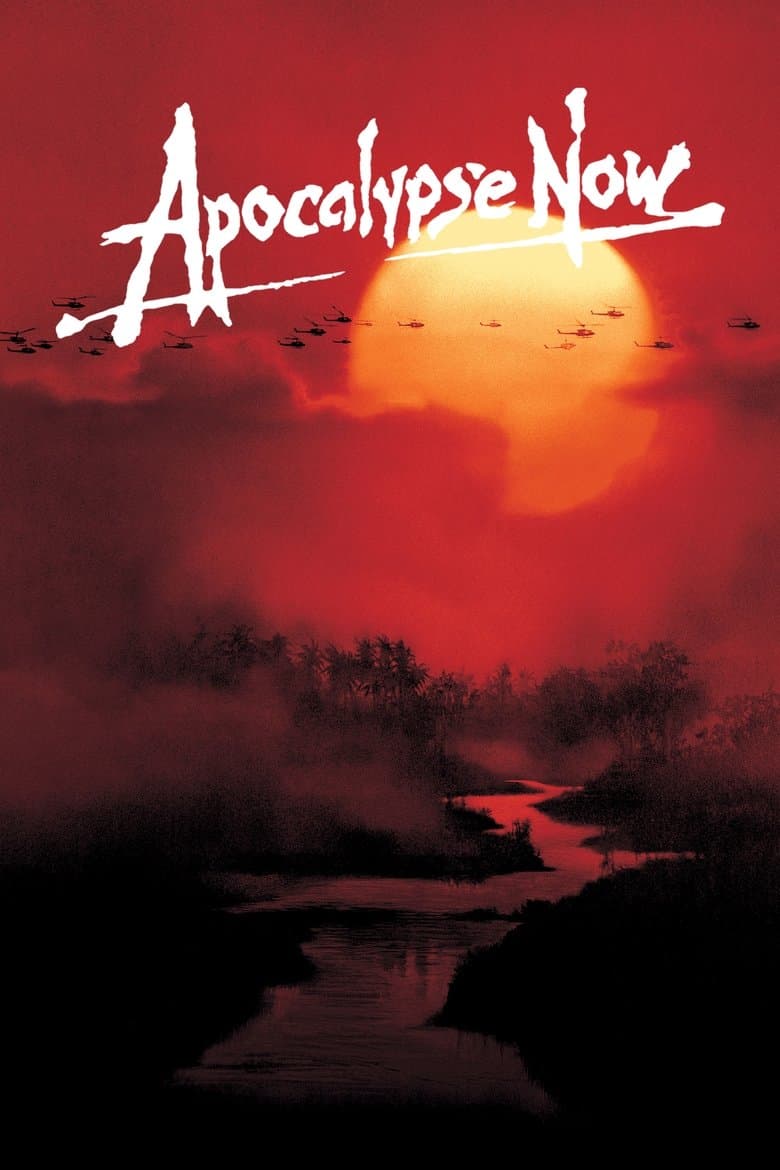
Francis Ford Coppola’s epic war film reimagines Joseph Conrad’s Heart of Darkness within the chaos of the Vietnam War. Captain Benjamin Willard is sent on a secret mission upriver into Cambodia to locate and eliminate Colonel Walter Kurtz, a once-decorated officer who has established his own cult-like command deep in the jungle. As Willard travels farther from civilization, the journey becomes an increasingly surreal descent into the psychological and moral devastation of war. Coppola’s ambitious production blends striking imagery, immersive sound design, and unforgettable performances from Martin Sheen and Marlon Brando. Both war spectacle and philosophical meditation, Apocalypse Now stands as one of the most haunting and ambitious portrayals of modern warfare ever filmed.
Watch for
- The iconic helicopter assault set to Wagner’s “Ride of the Valkyries,” blending spectacle with unsettling irony.
- Martin Sheen’s introspective performance as Captain Willard, whose journey mirrors a descent into moral uncertainty.
- The gradual buildup to Marlon Brando’s enigmatic Colonel Kurtz, whose presence dominates the film’s final act.
- Coppola’s dreamlike imagery and sound design, which blur the line between battlefield realism and psychological nightmare.
Production notes
Apocalypse Now was Francis Ford Coppola's notoriously chaotic production — a Vietnam-era reimagining of Joseph Conrad's Heart of Darkness, originally written by John Milius and substantially reworked by Coppola during the production. The shoot in the Philippines was famously beset by disasters: a typhoon destroyed the elaborate sets, Martin Sheen had a heart attack mid-production at age 36, Marlon Brando arrived overweight and underprepared (Coppola had to reshape the Kurtz character around Brando's actual condition), and the entire production fell years behind schedule and millions over budget. The cast included Robert Duvall as Lieutenant Colonel Kilgore, Frederic Forrest as Chef, Sam Bottoms as Lance B. Johnson, Albert Hall as Chief Phillips, Laurence Fishburne (then 14, appearing as 17) as Tyrone 'Clean' Miller, Dennis Hopper as the photojournalist, Harrison Ford in a small role, and Brando as Kurtz. Cinematographer Vittorio Storaro's painterly approach won him an Academy Award. The Wagner-derived 'Ride of the Valkyries' helicopter-attack sequence is one of the most-quoted in American cinema. Production cost approximately $31 million.
Trivia
- Martin Sheen suffered a near-fatal heart attack during production at age 36; he reportedly crawled to a road and flagged down help himself, and Coppola — fearing financial backers would shut down the production — initially concealed the incident from studio executives and the press.
- Marlon Brando arrived for production substantially overweight and reportedly without having read either Conrad's source novel or the screenplay; Coppola had to rewrite the entire Kurtz section around Brando's physical state, including the choice to keep him largely in shadow throughout his scenes.
- The famous typhoon that destroyed the production's elaborate sets in May 1976 set the production back several months and cost approximately $1.5 million; the disaster forced Coppola to take a six-week production hiatus and substantially exhausted the original budget.
- Eleanor Coppola, Francis's wife, documented the entire troubled production for the 1991 documentary Hearts of Darkness: A Filmmaker's Apocalypse, which has become one of the most celebrated 'making-of' documentaries ever produced and which provides extraordinary access to the production's chaos.
- The 'Ride of the Valkyries' helicopter-attack sequence has been continuously cited as one of the most influential war-cinema moments ever filmed; it directly inspired countless subsequent war films, including the Vietnam-era films of Oliver Stone and the contemporary action-cinema work of Michael Bay.
Legacy
Apocalypse Now is one of the canonical American films about the Vietnam War and one of the most thoroughly mythologized productions in Hollywood history. It received eight Academy Award nominations and won two (Best Cinematography for Vittorio Storaro and Best Sound). It was selected for the National Film Registry in 2000. The film's troubled production — typhoons, heart attacks, Brando's chaotic arrival, the years-long delay — became a template for the chaotic-auteur-production narrative that has shaped how Hollywood thinks about ambitious large-scale filmmaking. The 2001 release of Apocalypse Now Redux, a 49-minute extended version, reframed conversations about the film's structural choices. The 'Ride of the Valkyries' helicopter sequence has been continuously cited as one of the most influential war-cinema moments ever filmed, with direct lineage to subsequent war and action films across decades. The film's central thematic concern — the destruction of civilization's moral framework under conditions of total war — has aged into permanent relevance, with Apocalypse Now functioning as the canonical American treatment of war's psychological corruption.