An American in Paris
Vibe
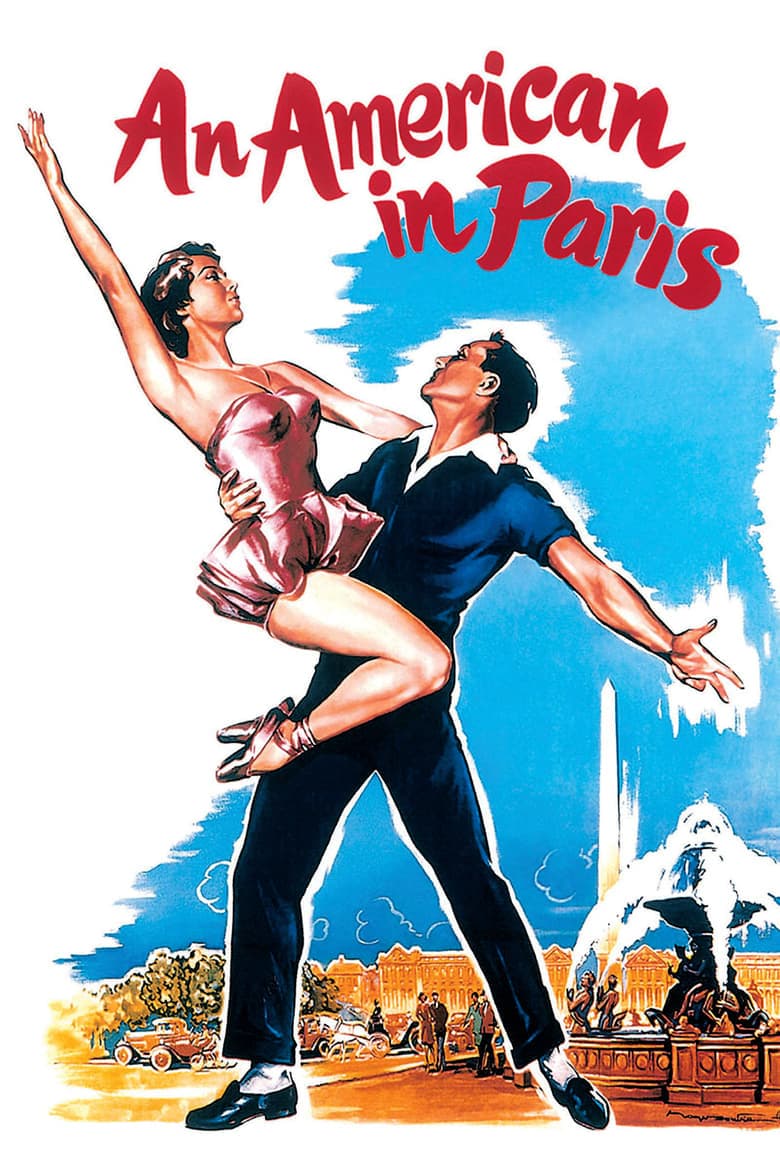
This vibrant musical follows Jerry Mulligan, an American ex-soldier and aspiring painter trying to make a life for himself in postwar Paris. As Jerry pursues artistic success, he becomes entangled in a web of romantic complications that forces him to choose between security, ambition, and genuine love. Directed by Vincente Minnelli, the film transforms Paris into a world of color, music, and stylized emotion, with George and Ira Gershwin’s songs providing its buoyant spirit. Gene Kelly’s athletic grace and expressive charm power the musical numbers, culminating in an extended ballet finale that fuses dance, painting, and cinematic fantasy. An American in Paris remains one of Hollywood’s most elegant and visually imaginative musicals.
Watch for
- Gene Kelly’s physical performance, especially the way his choreography blends athletic precision with emotional openness and romantic longing.
- Minnelli’s use of color, costume, and set design to create a Paris that feels more like a romantic artistic dream than a literal city.
- How the Gershwin songs are integrated into mood and character, giving the film a buoyant elegance rather than a stage-bound feel.
- The final ballet sequence, where narrative gives way to visual and musical expression, turning the film into a full-scale fantasy of love, art, and longing.
Production notes
An American in Paris was Vincente Minnelli's MGM musical built around George Gershwin's 1928 tone poem of the same name, with the screenplay by Alan Jay Lerner. The film was producer Arthur Freed's lavish reach for prestige-musical success at MGM, with Freed himself producing as part of his decade-long 'Freed Unit' run that included The Wizard of Oz, Meet Me in St. Louis, On the Town, and Singin' in the Rain. Gene Kelly played Jerry Mulligan, an American painter living in Paris, with Leslie Caron in her American film debut as Lise Bouvier, Oscar Levant as Adam Cook, Georges Guétary as the established singer Henri Baurel, and Nina Foch as the heiress Milo Roberts. The film's centerpiece — a 17-minute climactic ballet sequence set to the entire Gershwin tone poem, choreographed by Kelly and Carol Haney, designed in deliberately stylized European-modernist settings — became one of the most ambitious sequences in any Hollywood musical. Cinematographer Alfred Gilks (with John Alton handling the ballet sequence) shot the film. Production cost approximately $2.7 million.
Trivia
- Leslie Caron made her American film debut at age 19 in An American in Paris after Gene Kelly discovered her dancing in the Roland Petit ballet company in Paris; Kelly reportedly insisted on her casting against MGM's preference for an established American performer, and Caron's career launched directly from this film.
- The film's centerpiece — a 17-minute climactic ballet sequence set to the entire Gershwin tone poem — was choreographed by Gene Kelly and Carol Haney over approximately four weeks of rehearsal; the sequence's elaborate stylized European-modernist set designs, costumes, and lighting were inspired by paintings of Henri de Toulouse-Lautrec, Pierre-Auguste Renoir, and other late-19th-century French masters.
- An American in Paris won six Academy Awards including Best Picture, Best Original Screenplay (Alan Jay Lerner), Best Original Score (Johnny Green and Saul Chaplin), Best Cinematography (Color), Best Art Direction, and Best Costume Design — making it one of the most thoroughly Oscar-celebrated musical films of the era; the Best Picture win was particularly unexpected, with the film defeating A Streetcar Named Desire and A Place in the Sun.
- Gene Kelly received an Honorary Academy Award at the 24th ceremony 'in appreciation of his versatility as an actor, singer, director and dancer, and specifically for his brilliant achievements in the art of choreography on film' — recognition for his sustained influence on American musical filmmaking across the previous decade.
- Vincente Minnelli's direction of the climactic ballet sequence was substantially shaped by his own background in Broadway production design; Minnelli had been an art director before becoming a director, and his ability to integrate visual design with musical performance was central to the film's success.
Legacy
An American in Paris won six Academy Awards including Best Picture — defeating A Streetcar Named Desire and A Place in the Sun in one of the most contested Best Picture races of the early 1950s. It was selected for the National Film Registry in 1993. The film's centerpiece — the 17-minute climactic ballet sequence set to the entire Gershwin tone poem — has been continuously cited as one of the most ambitious sequences in any Hollywood musical, and its specific visual approach (deliberately stylized European-modernist sets inspired by Toulouse-Lautrec, Renoir, and other late-19th-century French masters) opened new territory for American musical film design. Leslie Caron's American film debut launched her three-decade career, including her subsequent Oscar-nominated work in Gigi (1958) and other MGM musicals. Gene Kelly's choreography on the film has been continuously studied as the canonical example of his approach to integrating dance with narrative cinema. Among musicals of the Freed Unit at MGM, An American in Paris sits alongside Singin' in the Rain (1952) as the most thoroughly realized achievement, though without quite the comedic accessibility that made Singin' in the Rain more permanently embedded in popular memory.