American Graffiti
Vibe
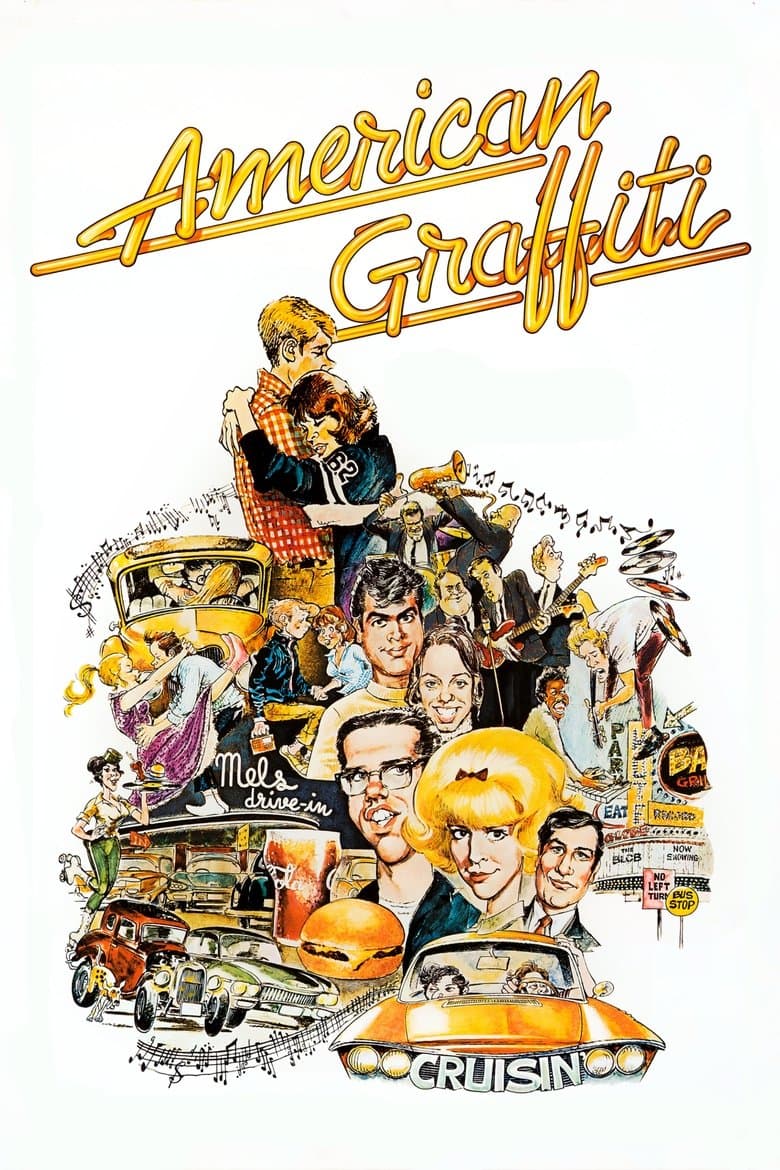
George Lucas’s nostalgic coming-of-age film unfolds over the course of a single summer night in 1962, following a group of teenagers cruising the streets of Modesto, California as they flirt, race, drift, and confront the uncertainty of what comes next. Through its loosely connected stories, the film captures a world poised between adolescence and adulthood, where friendships and romances feel both immediate and fleeting. Fueled by an almost nonstop soundtrack of early rock-and-roll hits, Lucas recreates youth culture with vivid specificity while giving the film a loose, documentary-like energy. American Graffiti became one of the defining films about teenage life, memory, and the end of innocence in postwar America.
Watch for
- How Lucas uses cars, radio, and nighttime streets to create a drifting, interconnected world where movement itself becomes the film’s narrative engine.
- The nonstop rock-and-roll soundtrack, which does more than set the period—it shapes mood, rhythm, and the emotional texture of nearly every scene.
- The ensemble structure, where small encounters and overlapping storylines gradually build a larger portrait of youth on the edge of change.
- The undercurrent of sadness beneath the fun, especially in the way the film treats cruising culture as both a celebration of freedom and a last glimpse of a disappearing American moment.
Production notes
American Graffiti was George Lucas's second feature film — his coming-of-age drama set in his hometown of Modesto, California on a single late-summer night in 1962, following a group of high school graduates on the eve of their departure for college and adult life. The screenplay by Lucas, Gloria Katz, and Willard Huyck drew on Lucas's own teenage experience in early-1960s Northern California. Universal Pictures was substantially skeptical of the project — the film was made for approximately $750,000 with a young, then-unknown cast, and Lucas was a 28-year-old with only one previous theatrical feature (the commercially-disappointing THX 1138). The cast included Richard Dreyfuss (Curt Henderson), Ron Howard (Steve Bolander), Paul Le Mat (John Milner), Charles Martin Smith (Terry Fields), Cindy Williams (Laurie), Candy Clark (Debbie), Mackenzie Phillips (Carol), Wolfman Jack (himself as the legendary DJ), and Harrison Ford in an early supporting role as the antagonistic out-of-town hot-rodder Bob Falfa. Cinematographer Haskell Wexler supervised the photography uncredited. Production took only 28 nights.
Trivia
- American Graffiti was George Lucas's project before Star Wars — and the commercial success of American Graffiti directly enabled Lucas's negotiating leverage with 20th Century Fox to make Star Wars on the terms that ultimately gave him merchandising rights and creative control.
- Universal Pictures was substantially skeptical of the project — the film was made for approximately $750,000 with a young, then-unknown cast, and Lucas was a 28-year-old with only one previous theatrical feature (THX 1138); Francis Ford Coppola served as executive producer to lend Hollywood credibility to the production.
- Harrison Ford was working as a carpenter when he was cast in his early supporting role as the antagonistic Bob Falfa; Ford and George Lucas had been friends since meeting during the production of Ford's earlier television work, and Lucas would later cast Ford as Han Solo in Star Wars on the strength of their continued professional relationship.
- American Graffiti's soundtrack — featuring approximately 41 popular songs from 1955-1962, with substantial Wolfman Jack (DJ Robert Smith) narration — became one of the most influential film soundtracks of the 1970s; the double-LP album was a commercial success and helped establish the 'classic-rock-and-roll-of-the-era' soundtrack approach that would be widely imitated.
- American Graffiti received five Academy Award nominations including Best Picture and Best Director (Lucas), winning none; the film lost Best Picture to The Sting in a year when both films grossed substantially above their relatively modest production budgets.
Legacy
American Graffiti was a substantial commercial success, grossing approximately $140 million worldwide on its $750,000 budget — one of the most profitable American films ever produced relative to its costs. It received five Academy Award nominations including Best Picture and Best Director (winning none). It was selected for the National Film Registry in 1995. The film's commercial success directly enabled George Lucas's subsequent negotiation with 20th Century Fox to make Star Wars (1977) on the terms that ultimately gave him merchandising rights and creative control — making American Graffiti the financial foundation for the Star Wars franchise. The film's specific approach to 1960s nostalgia — the integration of period music, the focus on single-night narrative structure, the ensemble cast of young actors — established the template for subsequent decades of similar work, including Lasse Hallström's Dazed and Confused (1993), Cameron Crowe's Almost Famous (2000), and Richard Linklater's Boyhood (2014). Many of the cast members went on to substantial careers — Harrison Ford to Star Wars and Indiana Jones, Richard Dreyfuss to Jaws and Close Encounters, Ron Howard to a long directing career.