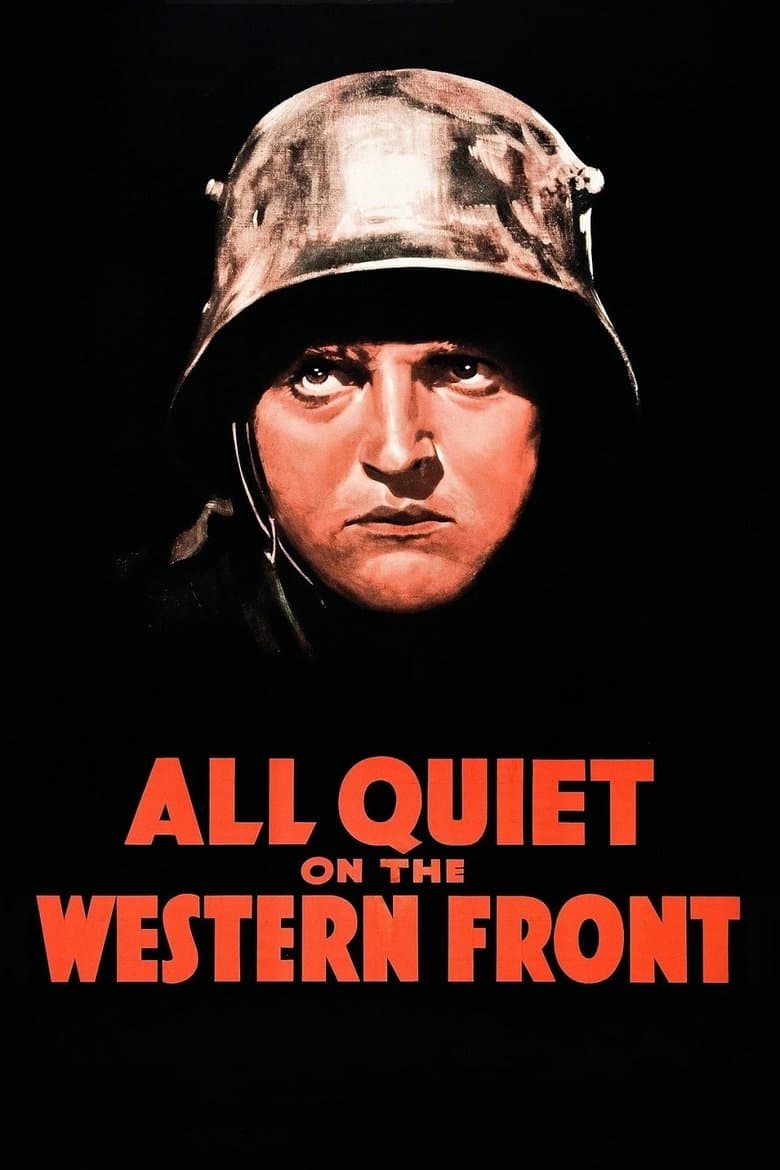
All Quiet on the Western Front
Vibe
Based on Erich Maria Remarque’s novel, this powerful antiwar drama follows a group of young German students who enthusiastically enlist to fight in World War I, only to have their patriotic illusions shattered by the reality of trench warfare. As the conflict grinds on, the film charts not heroic triumph but exhaustion, fear, and the slow destruction of a generation’s innocence. Directed by Lewis Milestone, it was groundbreaking for its fluid battle staging, stark realism, and refusal to romanticize combat. By focusing on the physical and psychological devastation of ordinary soldiers, All Quiet on the Western Front became one of the earliest and most influential antiwar films in cinema history.
Watch for
- Lewis Milestone’s fluid camera movement in the battle scenes, which gives the trenches and attacks a frightening immediacy uncommon for early sound cinema.
- How the film contrasts classroom idealism with battlefield reality, turning patriotic rhetoric into one of the story’s cruelest ironies.
- The gradual emotional and physical erosion of the young soldiers, whose friendship becomes one of the few fragile sources of meaning amid the destruction.
- The film’s quiet, devastating moments between battles, where exhaustion, fear, and disillusionment reveal the true human cost of war.
Production notes
All Quiet on the Western Front was Lewis Milestone's adaptation of Erich Maria Remarque's 1929 anti-war novel, with the screenplay by Maxwell Anderson, George Abbott, Del Andrews, and Milestone. Universal Pictures produced the film with substantial commitment to the source material's anti-militaristic perspective. The film was shot in 1929-1930 and required both silent and sound versions because of the era's continuing transition from silent to sound production. Lew Ayres played the young German soldier Paul Bäumer, with Louis Wolheim as Sergeant Katczinsky (Kat), Slim Summerville as Tjaden, John Wray as Himmelstoss, Ben Alexander as Kemmerich, and Russell Gleason as Müller. Cinematographer Arthur Edeson shot the film. The famous closing sequence — Paul reaching for a butterfly only to be shot by a French sniper — has become one of the most-quoted anti-war images in cinema. Production cost approximately $1.5 million.
Trivia
- Lew Ayres's experience on All Quiet on the Western Front led him to become a conscientious objector during World War II; Ayres refused to bear arms but volunteered as a medic, serving in the Pacific theater and earning citations for his battlefield medical work despite his pacifist position.
- The film was banned in Germany after the Nazi rise to power; on its 1930 German release, Nazi Party members organized riots in cinemas — releasing rats and stink bombs into theaters — eventually forcing the German government to ban the film, an act that became one of the most public early demonstrations of Nazi cultural censorship.
- Erich Maria Remarque's source novel, published in 1929, had sold approximately 2.5 million copies in 22 languages by 1930; the Nazi government banned Remarque's books and stripped his German citizenship after the 1933 rise to power, and Remarque spent the rest of his life in exile in Switzerland and the United States.
- Both silent and sound versions were produced because of the era's continuing transition from silent to sound — silent prints were distributed for theaters that had not yet been wired for sound, while the synchronized-sound version went to major-market theaters.
- All Quiet on the Western Front won the Academy Award for Best Picture and Best Director at the 3rd Academy Awards in 1930 — the second year of the Academy's existence — making it one of the earliest Best Picture winners and the only Best Picture-winning film in the Academy's first decade to remain in the AFI Top 100.
Legacy
All Quiet on the Western Front won two Academy Awards including Best Picture and Best Director — making it one of the earliest Best Picture winners and one of the first Hollywood films to receive a Best Picture from a non-American perspective on World War I. It was selected for the inaugural class of the National Film Registry in 1990. The film's specific German-soldier perspective and its anti-militaristic register were extraordinarily ahead of their time for 1930; the film established the template for the entire subsequent anti-war film tradition, with direct lineage to Stanley Kubrick's Paths of Glory (1957), Lewis Milestone's own A Walk in the Sun (1945), and modern films from Apocalypse Now (1979) to 1917 (2019). The closing butterfly sequence — Paul Bäumer reaching for life and being shot in the act — has become one of the most-quoted anti-war images in cinema, regularly referenced and parodied across subsequent decades. Edward Berger's 2022 German-language remake won the Academy Award for Best International Feature Film, returning the source material to its original linguistic context nearly a century after the original.