The African Queen
Vibe
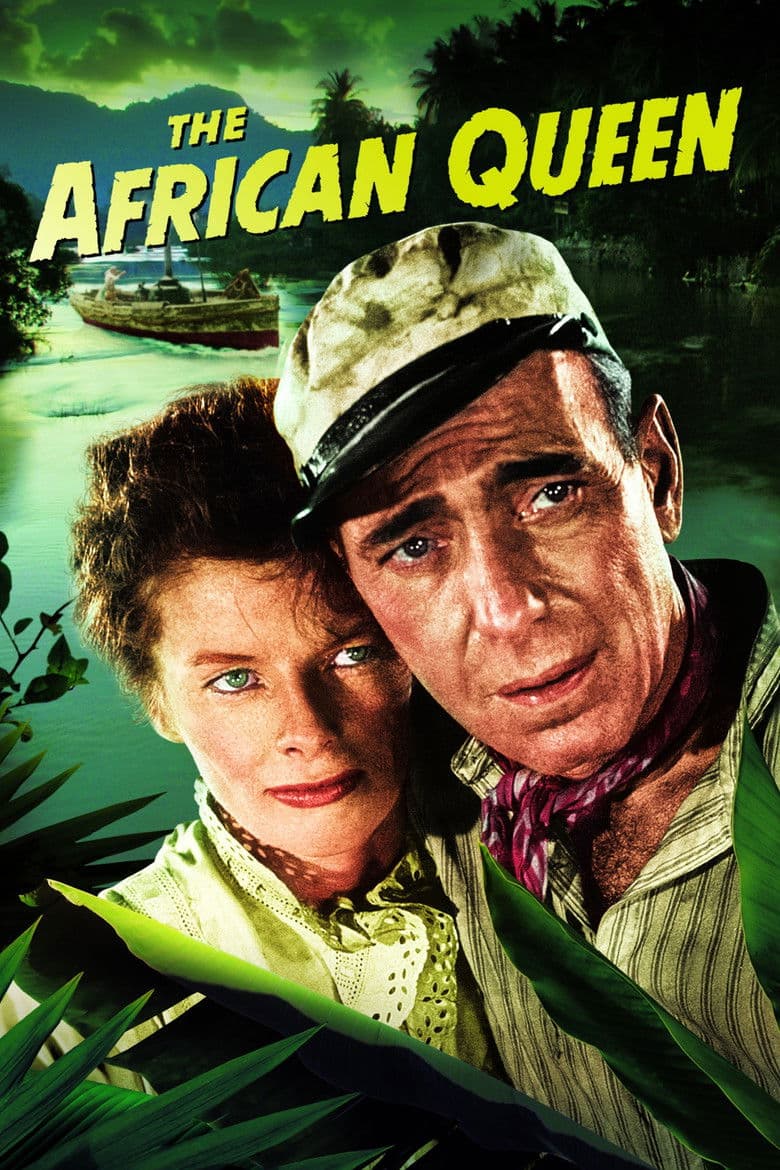
Set during World War I in German East Africa, The African Queen pairs two unlikely companions on a perilous river journey. Rose Sayer, a proper English missionary, persuades rough-edged riverboat captain Charlie Allnut to help her sabotage a German gunboat that dominates the region’s waterways. Traveling down dangerous rapids and through hostile territory, the mismatched pair slowly transform from reluctant partners into devoted allies—and eventually something more. Directed by John Huston and filmed largely on location in Africa, the film blends adventure, humor, and rich character development. Humphrey Bogart won his only Academy Award for his performance as Charlie, while Katharine Hepburn’s spirited Rose provides the perfect counterbalance in this enduring romantic adventure.
Watch for
- The evolving chemistry between Bogart and Hepburn, as their characters shift from irritation and distrust to genuine affection.
- The river journey itself, which functions both as a thrilling adventure and as a metaphor for the characters’ emotional transformation.
- Huston’s use of real African landscapes, giving the film a rugged, unpredictable atmosphere.
- Moments of humor and resilience that balance the danger and hardship of the voyage.
Production notes
The African Queen was John Huston's adaptation of C.S. Forester's 1935 novel, with the screenplay by Huston and James Agee. The production was famously punishing: Huston insisted on shooting on location in the Belgian Congo and Uganda — an unprecedented decision for a major Hollywood production of the era — and the cast and crew suffered from dysentery, malaria, leeches, and extreme heat. Humphrey Bogart played Charlie Allnut opposite Katharine Hepburn as the missionary Rose Sayer. Bogart and Lauren Bacall (his wife, present on set) drank heavily through production and reportedly emerged healthier than the cast and crew who tried to follow the local water-safety guidance. Cinematographer Jack Cardiff shot the film in Technicolor under brutal field conditions. Composer Allan Gray contributed the score. The film took approximately five months to shoot. Production cost approximately $1 million. Hepburn later wrote a memoir about the production titled The Making of The African Queen, or How I Went to Africa with Bogart, Bacall and Huston and Almost Lost My Mind (1987), which became one of the most beloved film-production memoirs.
Trivia
- Humphrey Bogart and Lauren Bacall (his wife, accompanying him on set) reportedly drank Scotch through most of the production and emerged healthier than crew members who followed the local water guidance; Bogart later said the film 'taught me to never go on location again.'
- Director John Huston was reportedly more interested in big-game hunting during production than in directing the film; cast members complained that he disappeared for days at a time, leaving them to manage the chaos of African location shooting on their own.
- Katharine Hepburn wrote a memoir about the production — The Making of The African Queen, or How I Went to Africa with Bogart, Bacall and Huston and Almost Lost My Mind (1987) — which has become one of the most beloved Hollywood memoirs and a frequent reference for film historians.
- Humphrey Bogart won the Academy Award for Best Actor for his performance — the only Oscar he ever received in his career — defeating Marlon Brando (A Streetcar Named Desire), Montgomery Clift (A Place in the Sun), Arthur Kennedy (Bright Victory), and Fredric March (Death of a Salesman) in one of the strongest competitive years of the 1950s.
- The river boat 'African Queen' that gives the film its title was shipped from England to Lake Albert in Africa for production; it has subsequently been preserved and is currently exhibited at Holiday Marina in Key Largo, Florida, where visitors can take rides on the original boat.
Legacy
The African Queen won Humphrey Bogart his only Academy Award (Best Actor), and was selected for the National Film Registry in 1994. The production became Hollywood folklore — the location-shooting chaos, the disease and discomfort, the larger-than-life behavior of Bogart, Hepburn, and Huston — and Hepburn's memoir about it has become one of the most widely-read film-production books ever published. The film established the template for the Hepburn-and-elder-male-character pairings that would extend across her later career (Rooster Cogburn with John Wayne, On Golden Pond with Henry Fonda). Its 1991 colorized Turner Network broadcast became a touchstone in American cultural debates about film colorization, with critics objecting to Turner's reformatting of the original black-and-white work. Among on-location productions of the studio era, The African Queen remains the most extreme — and the most influential — case of director-and-cast embracing real geographical and physical hardship for the sake of authentic visual environment. Its central romance between Bogart and Hepburn has remained one of the most beloved Hollywood pairings of the period.